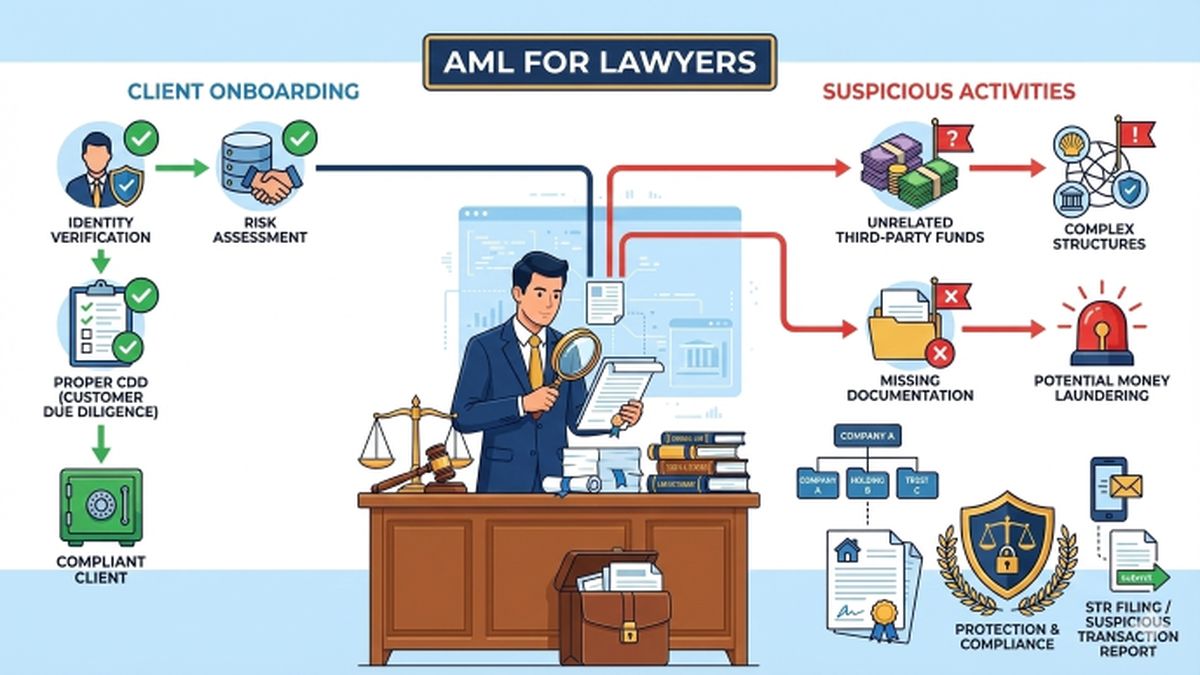
AML for Lawyers: When Legal Privilege Meets Financial Crime Prevention
- juliachinjfourth
- 1 day ago
- 19 min read

Six law firms. Five lawyers. S$200,000 in penalties.
The properties they helped convey were valued at over S$900 million. The fees they collected? As low as S$15,000 per firm.
In August 2025, Singapore's Ministry of Law named the law practices penalised for anti-money laundering breaches connected to the country's largest money laundering case - S$3 billion in assets seized, over 200 properties confiscated, 10 foreign nationals arrested.
Anthony Law Corporation: S$100,000 fine.
Legal Solutions LLC: S$70,000 fine.
Fortis Law Corporation: S$30,000 fine
Reprimanded: William Poh & Louis Lim, Templars Law LLC, and Malkin & Maxwell LLP.
Individual accountability: 5 lawyers referred to the Law Society for disciplinary action.
The math is uncomfortable. The message is clear.
Lawyers remain a primary target for criminals seeking one thing they desperately need: legitimacy.
A transaction blessed by a law firm looks clean, even when it isn't. A structure created by lawyers carries the imprimatur of professional respectability. A client account at a law firm provides access to the banking system without the scrutiny banks themselves would apply.
The regulatory "honeymoon period" is officially over.
Why Criminals Need Lawyers
Criminals don't choose lawyers for their legal brilliance. They choose them for their legitimacy.
Banks ask questions. Banks file suspicious transaction reports. Banks have compliance departments with transaction monitoring systems and dedicated AML teams.
Lawyers? Lawyers have client accounts. They have professional privilege. They have the ability to create structures, move funds, and facilitate transactions - all under the protective umbrella of the legal profession.
What lawyers provide that criminals need:
Service | Legitimate Purpose | Criminal Exploitation |
Client accounts | Holding funds for transactions | Moving money outside normal banking scrutiny |
Property conveyancing | Facilitating real estate purchases | Integrating illicit funds into legitimate assets |
Company formation | Business structuring | Creating vehicles for money laundering |
Trust creation | Estate planning, asset protection | Obscuring beneficial ownership |
Litigation settlements | Resolving disputes | Creating legitimate explanations for fund movements |
Escrow services | Securing transactions | Layering funds through professional accounts |
Professional introductions | Connecting clients to services | Providing access to banks and other gatekeepers |
FATF identifies seven high-risk activities where lawyers act as the "front door" to the financial system:
Misuse of client accounts: holding or moving funds without adequate source verification
Purchase of real property: the primary vector in the S$3B case
Creation of trusts and companies: building the architecture of anonymity
Management of trusts and companies: ongoing administration that maintains opacity
Managing client affairs and making introductions: leveraging professional networks
Undertaking certain litigation: creating paper trails that legitimise fund movements
Setting up and managing charities: exploiting the perception of philanthropic purpose
The common thread: lawyers provide access and legitimacy that criminals cannot obtain on their own.
The Elephant in the Room: Legal Professional Privilege
The greatest tension for lawyers is between Legal Professional Privilege (LPP) and the duty to report suspicious activity.
Lawyers are trained to protect client confidentiality. It's fundamental to the profession. Without it, clients cannot speak freely, and lawyers cannot provide effective advice.
But privilege was never intended to facilitate crime.
Global jurisprudence in recent times has clarified two critical points:
The Economic Distinction
Regulators distinguish between:
Legal Advice (protected) providing opinions on legal rights and obligations
Financial Facilitation (not protected) moving money, conveying property, creating structures
If you are moving money or conveying property, you are acting as a financial gatekeeper. Privilege does not shield these activities from AML obligations.
The Crime-Fraud Exception
Privilege never applies if a lawyer's services are used to further a crime, even if the lawyer is an unwitting participant.
The protection exists for legitimate legal advice. It does not exist to shield transactions that, had the lawyer asked the right questions, would have revealed criminal purpose.
The practical implication: When a lawyer fails to conduct adequate due diligence and subsequently discovers the transaction was criminal, they cannot claim privilege prevented them from asking questions. The obligation to know your client exists precisely to prevent unwitting facilitation.
FATF's 5th Round of Mutual Evaluations
The 5th Round of Mutual Evaluations emphasises effectiveness over technical compliance. Jurisdictions will be assessed not on whether they have lawyer AML regulations, but on whether those regulations actually prevent money laundering.
The question has changed from "Do lawyers have obligations?" to "Are those obligations working?"
The Core Shift: From Technical Compliance to Effectiveness
The 6-Year Cycle: Evaluations are now 40% more frequent than the previous round. Scrutiny is constant, not periodic.
The 3-Year Deadline: Jurisdictions must fix "Significant Deficiencies" within 3 years or face the FATF Grey List, with direct consequences for every law firm in that jurisdiction.
The Proliferation Financing (PF) Mandate: For the first time, lawyers must assess and mitigate the risk of sanctions evasion and the financing of weapons of mass destruction.
FATF's July 2024 Horizontal Review of Gatekeepers found that cornerstone obligations - CDD, internal controls, and risk-based supervision, consistently lag in the legal sector.
The headline finding: 7 FATF member jurisdictions representing more than half of the world's GDP scored below 50% on gatekeeper compliance.
The gap isn't in the rules. It's in the enforcement, and that's changing.
The Global Crackdown: Case Studies
1. Singapore's S$3 Billion Case
The largest money laundering case in Singapore's history revealed how lawyers facilitated the integration of illicit funds into legitimate assets.
The scale:
S$3 billion in assets seized
Over 200 properties valued at S$370+ million
Luxury vehicles, jewellery, gold bars, cryptocurrency
10 foreign nationals arrested
Assets spread across Singapore and multiple offshore jurisdictions
The lawyer connection:
The individuals convicted used Singapore law firms to convey properties - the final step in integrating criminal proceeds into the legitimate economy. The lawyers asked few questions. They accepted explanations at face value. They failed to verify source of funds.
What went wrong at each firm:
Anthony Law Corporation acted for 9 clients on 25 properties worth approximately S$135 million. They failed to verify why transactions were funded by unrelated third parties. When money comes from someone other than your client, that's not a minor irregularity - it's a fundamental red flag.
Fortis Law Corporation failed to verify claims that payments originated from "legitimate" remittance companies. Remittance companies are a classic layering mechanism. The explanation should have triggered enhanced scrutiny, not acceptance.
Legal Solutions LLC failed to document client risk analysis or perform Enhanced Due Diligence after filing Suspicious Transaction Reports. Filing an STR is not the end of your obligation - it's an acknowledgment that something is wrong. Continuing the relationship without enhanced measures defeats the purpose.
Malkin & Maxwell LLP relied on checks "assumed" to have been done by third parties. In AML, your CDD obligation is yours alone. You cannot outsource it. You cannot assume someone else did it. If you can't prove you did due diligence, you didn't do due diligence.
2. Op Northern Star: The Penang Case Study
The risk isn't confined to Singapore. In mid-2025, Malaysian authorities launched Op Northern Star, a massive crackdown on money laundering linked to a major Ponzi scheme.
The fallout in Penang:
Prominent lawyers detained: Two Penang-based lawyers, both holding the "Datuk" title, were hauled up for questioning.
Seizure of documents: Police seized files related to high-value stock transactions and real estate conveyancing, alleging that funds were laundered through luxury property developments and penny stock manipulation.
Professional complicity: Investigators highlighted that the scheme relied on a network of "legitimate" professionals. As one senior lawyer in Georgetown noted: "One out of five professionals here ... are in some way inadvertently involved."
The shift in regulatory approach:
This case highlighted that regulators are no longer treating professionals as "victims" of their clients' deception. They are treating them as active gatekeepers who failed to look behind the curtain.
The distinction matters. A victim is someone who was deceived despite reasonable precautions. A failed gatekeeper is someone who didn't take reasonable precautions in the first place.
The lawyers in Penang may not have known their clients were criminals. But did they ask the right questions? Did they verify source of funds? Did they question why a client needed complex structures or rapid transactions?
If the answer is no, "I didn't know" is not a defence. It's an admission.
3. The Danske Bank Ecosystem
The Danske Bank scandal - €200 billion in suspicious transactions through the bank's Estonian branch, wasn't just a banking failure. It was an ecosystem failure that included lawyers at multiple points.
The lawyer connection:
Law firms created the shell companies that held accounts at the Estonian branch
Lawyers provided nominee directors and registered offices
Legal structures obscured beneficial ownership from the bank's compliance team
Professional intermediaries added layers of apparent legitimacy
The bank saw transactions. But the architecture that made those transactions possible - the shell companies, the nominee arrangements, the complex ownership structures, was built by lawyers and other professional service providers.
Key insight: By the time suspicious funds reach a bank account, the laundering infrastructure is already in place. Lawyers who create that infrastructure without adequate due diligence are not peripheral to the crime. They are foundational to it.
4. The Pandora Papers: Lawyers Exposed
The 2021 Pandora Papers leak exposed how law firms in multiple jurisdictions helped politicians, public officials, and wealthy individuals create opaque structures.
What the papers revealed:
Law firms actively marketed secrecy as a service
Lawyers created structures specifically designed to defeat beneficial ownership enquiries
Some firms continued acting for clients even after red flags emerged
Professional privilege was invoked to resist disclosure, even for clearly non-privileged activities
The regulatory response:
Beneficial ownership registries have been strengthened globally. The EU's AML Package requires enhanced transparency. The UK's Economic Crime and Corporate Transparency Act 2023 gives authorities new powers to pierce corporate veils.
The opacity that lawyers once helped create is becoming harder to maintain and the lawyers who created it are facing scrutiny.
How Criminals Exploit Lawyers
FATF and national regulators have documented multiple methods criminals use to exploit legal
professionals:
Method | Legitimate Purpose | Criminal Exploitation |
Client account | Holding settlement funds or retainers. | Moving money outside the bank's transaction monitoring "eye." Funds appear as legitimate legal transactions |
Conveyancing | Facilitating the transfer of property | Conveyancing legitimises the final placement of funds - converting "dirty" funds into "clean" real estate assets. |
Structure creation | Instructing lawyers to form companies and trusts | Professional involvement adds apparent legitimacy |
Litigation | Resolving genuine commercial disputes | "Litigation Laundering": Settling a sham lawsuit to move funds with a court-backed paper trail. |
Retainer abuse | Paying large retainers, then requesting refunds | Converts dirty money into clean law firm cheques |
Professional introduction | Using lawyer relationships to access banks | Lawyer referral reduces bank scrutiny |
Escrow exploitation | Holding funds in escrow for fabricated transactions | Lawyer accounts bypass normal banking controls |
Privilege shield | Claiming privilege to prevent disclosure | Exploits legitimate protection for illegitimate purposes |
Shelf companies | Saving time for legitimate startups | Providing a company with "aged" respectability to bypass new-account filters. |
The sophistication varies. Some criminals use lawyers for simple property purchases. Others build elaborate structures involving multiple firms across multiple jurisdictions.
But the principle is the same: lawyers provide legitimacy that criminals cannot obtain on their own.
Red Flags: What Should Trigger Scrutiny
Client Red Flags
🚩 The "Unknown" UBO: Use of complex shell companies where the ultimate controller is obscured
🚩 Avoidance of contact: Reluctance to meet in person or provide source of wealth documentation
🚩 Third-party funding: Fees or transaction funds arriving from unrelated individuals or offshore entities
🚩 Inconsistent profile: Client's stated occupation doesn't match the transaction value or complexity
🚩 Unusual knowledge: Client displays detailed understanding of AML thresholds or reporting requirements
🚩 PEP connections: Client is or is connected to politically exposed persons without credible explanation
🚩 Jurisdiction hopping: Client has recently moved from a high-risk jurisdiction or uses multiple passports
🚩 Intermediary instructions: Another professional instructs on behalf of an undisclosed client
🚩 Cash-intensive business: Client's stated business is cash-heavy but transactions are all electronic
🚩 Adverse media: Client or associated parties appear in negative news coverage
Transaction Red Flags
🚩 No legal logic: Engaging a lawyer for tasks that don't require legal expertise
🚩 Urgency and secrecy: Demanding rapid closing or bypassing verification due to "confidentiality"
🚩 Overpayment of fees: Paying large retainers and immediately requesting refunds to different accounts
🚩 Price indifference: Client unconcerned about property value, legal fees, or transaction terms
🚩 Third-party payments: Funds arriving from parties with no apparent connection to the transaction
🚩 Unusual payment methods: Requests to receive or send funds through unconventional channels
🚩 Back-to-back transactions: Rapid purchase and sale of the same asset with no apparent commercial logic
🚩 Nominee requests: Client wants the lawyer or others to hold assets on their behalf
🚩 Offshore complexity: Transaction involves multiple jurisdictions with no clear business rationale
🚩 Settlement manipulation: Litigation settled quickly for amounts that don't reflect the dispute's merits
Structural Red Flags
🚩 Layered ownership: Companies owned by companies owned by trusts across multiple jurisdictions
🚩 Bearer instruments: Use of bearer shares or other instruments that obscure ownership
🚩 Circular structures: Ownership arrangements designed to defeat beneficial ownership enquiries
🚩 Nominee directors: Requests for nominee arrangements without legitimate privacy rationale
🚩 Shell companies: Entities with no apparent business operations, employees, or substance
🚩 Trust opacity: Discretionary trusts with vague beneficiary classes designed to obscure control
🚩 Rapid formation: Urgent requests for multiple entities with minimal explanation
🚩 Aged companies: Requests to purchase pre-existing companies for apparent business history
Typologies: How Lawyers Get Exploited
Typology 1: The Third-Party Funder
A client instructs a law firm to handle the purchase of a S$5 million residential property. The client provides identification and explains they are a successful businessperson.
When it's time to complete, the funds arrive not from the client but from an offshore company in a different name. The client explains this is their "family investment vehicle." No documentation is provided to verify the connection.
The lawyer proceeds with the transaction. The property is registered in the client's name.
Red flags: Third-party funding with no documented connection; offshore source; explanation accepted without verification; high-value residential property.
What should happen: The lawyer should require documentation establishing the relationship between the client and the funding entity. Beneficial ownership of the offshore company should be verified. Source of funds within the offshore company should be understood. If these cannot be established, the transaction should be declined.
What went wrong in the S$3B case: Anthony Law Corporation acted on 25 properties worth S$135 million without verifying why transactions were funded by unrelated third parties. This typology played out repeatedly.
Typology 2: The Remittance Explanation
A client purchases multiple properties over 18 months, each transaction funded by transfers from overseas. When asked about source of funds, the client explains the money comes from "legitimate remittance companies" in their home country.
The lawyer accepts this explanation. No verification is conducted. No documentation is requested showing the underlying source of the funds being remitted.
Red flags: Multiple high-value transactions; overseas funding; "remittance company" explanation without underlying source verification; pattern of purchases.
What should happen: Remittance companies move money - they don't create it. The question isn't whether a remittance company was used, but where the money came from before it reached the remittance company. The lawyer should require documentation of the ultimate source of funds, not just the transmission mechanism.
What went wrong in the S$3B case: Fortis Law Corporation accepted "legitimate remittance company" explanations without verifying the underlying source. Remittance is a method of transfer, not a source of wealth.
The deeper problem: Remittance companies are a classic layering mechanism. Criminals use them precisely because they create a break in the paper trail. The money enters the remittance system in one country and exits in another and the underlying source disappears from view.
A lawyer who accepts "remittance company" as a source of funds answer has accepted a non-answer. The question remains: where did the money come from before it was remitted?
Typology 3: The STR
A law firm files a Suspicious Transaction Report on a client. The transaction has characteristics that triggered concern - unusual funding patterns, vague explanations, connections to high-risk jurisdictions.
But after filing the STR, the firm continues acting for the client. No Enhanced Due Diligence is conducted. No additional verification is sought. The relationship proceeds as normal.
When regulators later investigate, the firm points to the STR as evidence of compliance. "We reported it," they say.
Red flags: STR filed but no change in approach; continued relationship without enhanced measures; treating STR as the end of the process rather than the beginning.
What should happen: Filing an STR is an acknowledgment that something is wrong. It should trigger Enhanced Due Diligence, not business as usual. The firm should seek to resolve the concerns through additional verification, documentation, or explanation. If the concerns cannot be resolved, the relationship should be terminated.
What went wrong in the S$3B case: Legal Solutions LLC filed STRs but failed to document client risk analysis or perform Enhanced Due Diligence afterward. The STR became a box-ticking exercise rather than a meaningful response to identified risk.
Typology 4: The Assumed Due Diligence
A lawyer receives instructions from another professional - an accountant, a corporate service provider, or another law firm, to act on a transaction. The instructing professional assures them that "all due diligence has been done."
The lawyer proceeds without conducting their own verification. They assume the other professional has fulfilled the CDD obligations. They don't ask to see the documentation. They don't verify the beneficial owner independently.
When the transaction later proves to be connected to money laundering, the lawyer claims they relied on the other professional's assurances.
Red flags: Instructions from intermediaries; assurances of due diligence without documentation; no independent verification; reliance on third-party compliance.
What should happen: In AML, your CDD obligation is yours alone. You cannot outsource it. You cannot assume someone else did it. You cannot rely on assurances without verification. If you are conducting a transaction that triggers AML obligations, you must conduct your own due diligence, regardless of what other professionals claim to have done
.
What went wrong in the S$3B case: Malkin & Maxwell LLP relied on checks "assumed" to have been done by third parties. Assumption is not compliance. If you can't prove you did due diligence, you didn't do due diligence.
Typology 5: The Retainer Refund
A new client engages a law firm for "potential litigation." They pay a substantial retainer, $500,000, by wire transfer from an offshore account.
Two weeks later, the client instructs that the litigation will not proceed. They request a refund of the retainer, minus a small fee for the firm's time. But they want the refund sent to a different account, a domestic bank account in a different name, which they explain belongs to their "local representative."
The firm processes the refund. The S$500,000 that arrived from an offshore account in one name leaves as a law firm cheque to a domestic account in another name.
Red flags: Large retainer for unspecified services; rapid change of instructions; refund requested to different account/name; no actual legal work performed; offshore source, domestic destination.
What should happen: The pattern is classic money laundering using the law firm's client account to convert funds from one form to another. The firm should question why the retainer is being refunded so quickly. They should refuse to send funds to a different account or name than the source. They should consider whether the "litigation" was ever genuine or merely a pretext for moving money.
Typology 6: The Urgent Property Purchase
A client contacts a law firm on Friday afternoon. They need to complete a property purchase by Monday. The property is valued at S$8 million. The client is willing to pay premium fees for expedited service.
When asked about source of funds, the client provides a bank statement showing the funds are available. But the statement shows a large deposit made just three days ago, with no explanation of origin.
The client explains they are relocating for business and need to secure housing immediately. They pressure the firm to proceed quickly, emphasising that any delay will cause them to lose the property.
Red flags: Extreme urgency with no credible explanation; high-value transaction; recent large deposit
with unexplained origin; pressure to bypass normal procedures; willingness to pay premium fees.
What should happen: Urgency is not a reason to skip due diligence. It's a reason to enhance it! The firm should understand why the timeline is critical. They should verify the source of the recent deposit, not just its existence. If adequate due diligence cannot be completed in the timeframe, the firm should decline the engagement.
The pressure trap: Criminals use urgency deliberately. They know that time pressure causes shortcuts. They know that the fear of losing a fee, or losing a client, can override professional judgment. The urgent client who can't wait for due diligence is often the client who can't withstand due diligence.
Typology 7: The Litigation Settlement
Two companies are engaged in litigation. The dispute involves a contract worth S$2 million. After months of proceedings, the parties suddenly settle, for S$15 million, paid by the defendant to the plaintiff.
The settlement amount bears no relationship to the underlying dispute. The defendant's lawyers don't question why their client is paying seven times the contract value. The plaintiff's lawyers don't question why they're receiving a windfall.
The S$15 million is paid through the lawyers' client accounts. It emerges clean on the other side, a legitimate litigation settlement, documented by court filings.
Red flags: Settlement amount disproportionate to dispute value; rapid settlement after prolonged litigation; no commercial logic to the terms; both parties seemingly satisfied with inexplicable outcome.
What should happen: Lawyers should understand the commercial logic of settlements they facilitate. When a settlement makes no sense — when a defendant pays far more than they could possibly owe, or a plaintiff accepts far less than they could win - that's a red flag. The transaction may be using litigation as a mechanism to move money with a legitimate paper trail.
The Human Cost
It's tempting to view lawyer AML compliance as a regulatory burden - more paperwork, more procedures, more boxes to tick.
But behind the shell companies and property transactions are real victims.
Corruption victims: When a government official loots public funds and uses lawyers to purchase properties abroad, citizens of that country lose. Schools aren't built. Hospitals lack resources. Development stalls. The lawyer who facilitated the purchase, without asking where a mid-level official found S$10 million, participated in that harm.
Fraud victims: When criminals run investment scams and use lawyers to create the corporate structures, real people lose their savings. Retirement funds vanish. Life plans collapse. The lawyer who formed the company, without questioning why it needed nominee directors and an offshore structure — helped build the fraud machinery.
Sanctions evasion victims: When sanctioned individuals use lawyers to access the financial system, the sanctions regime is undermined. Authoritarian regimes are strengthened. Human rights abusers continue operating. The lawyer who didn't screen their client, or who accepted a convenient explanation for red flags enabled that evasion.
The families destroyed: Behind every money laundering case are victims whose lives were damaged by the underlying crime. Drug trafficking destroys families. Human trafficking destroys lives. Corruption destroys communities. The money being laundered represents human suffering and lawyers who facilitate its movement, however unwittingly, participate in that chain.
The S$3 billion case wasn't victimless. The money came from somewhere. It was generated by crimes that harmed real people. The lawyers who helped integrate it into Singapore's property market didn't just fail a compliance obligation. They helped complete a chain of harm that started with victims they never saw.
That's what AML for lawyers is really about. Not paperwork. Not box-ticking. But refusing to provide legitimacy to transactions that serve criminals at the expense of victims.
The Capacity Gap - And How to Close It
Here's the reality: not every law firm has a dedicated compliance department.
Small practices handle conveyancing alongside family law and commercial disputes. Solo practitioners manage their own files, their own billing, and their own compliance. They don't have transaction monitoring software. They may not have a dedicated MLRO.
But they're handling transactions that can move millions into the legitimate economy.
The capacity gap is real. But it's not an excuse, and regulators aren't waiting.
What law firms of any size can do today:
1. Know Your Client - Really Know Them
Don't just collect identification documents. Understand who you're dealing with. What's their business? Where does their money come from? Why do they need this transaction? If the answers don't make sense, ask more questions.
The S$3B case firms collected identification. They had files. But they didn't understand their clients — they didn't ask why funds were coming from unrelated third parties, or what business generated the wealth to purchase S$135 million in properties.
2. Know the Beneficial Owner - Not Just the Instructing Party
When another professional instructs you on behalf of a client, that's not the end of your due diligence — it's the beginning. When a company is purchasing property, you need to know who ultimately owns and controls that company. "My client prefers confidentiality" is not an acceptable answer.
3. Verify Source of Funds - Not Just Source of Payment
There's a critical distinction:
Source of payment: Where did the money come from immediately before it reached you?
Source of funds: Where did the money originate? What activity generated it?
A bank transfer shows source of payment. A remittance company shows source of payment. But neither answers the real question: what legitimate activity generated this wealth?
4. Treat STRs as the Beginning, Not the End
Filing a Suspicious Transaction Report is not a "get out of jail free" card. It's an acknowledgment that something is wrong. If you've identified concerns serious enough to report, you should be conducting Enhanced Due Diligence, not continuing business as usual.
5. Document EVERYTHING
If you can't prove you did due diligence, you didn't do due diligence. Keep records of:
Customer identification and verification
Beneficial ownership enquiries
Source of funds verification
Risk assessments and their rationale
Any red flags identified and how they were resolved
The S$3B case firms thought they did enough. They couldn't prove it. Documentation isn't bureaucracy - it's protection.
6. Don't Rely on Others
Your CDD obligation is yours alone. You cannot outsource it to another professional. You cannot assume the bank did it. You cannot rely on assurances without verification. If you're conducting a transaction that triggers AML obligations, you must conduct your own due diligence.
7. Train Everyone
AML isn't just for partners or compliance officers. Every lawyer who handles client matters needs to understand red flags. Every secretary who processes payments needs to know what looks suspicious. Every associate who takes instructions needs the authority to escalate concerns.
8. Create a Culture Where "No" Is Acceptable
The hardest part of compliance isn't identifying red flags. It's acting on them. When a high-fee client presents unacceptable risk, lawyers need the authority and the support to decline. Firms need cultures where raising concerns is rewarded, not punished, where losing a suspicious client is better than losing a licence.
The PULSE Approach
Under FATF Recommendation 22, core obligations are non-negotiable. But compliance isn't just about meeting minimum requirements, it's about building systems that actually work.
The PULSE framework provides a structure for effectiveness:
P - Purpose
Recognise that your "duty to the court" now includes a duty to the integrity of the global financial system. You are not just a legal advisor, you are a gatekeeper. Every transaction you facilitate either enables or prevents financial crime. There is no neutral ground.
U - Unified Standards
Ensure your conveyancing, corporate, and litigation teams use identical, rigorous CDD standards. The same client presenting the same red flags should receive the same scrutiny regardless of which practice area they approach. Criminals look for the path of least resistance within firms, not just between them.
L - Leadership
Senior partners must own compliance — not delegate it. They must empower juniors to flag "uncomfortable" deals without fear of losing billable targets. They must create a culture where the question "Where did this money come from?" is always acceptable, regardless of the client's importance or the fee at stake.
S - Screening
Implement real-time screening for sanctions and PEPs. Manual checks are no longer defensible in 2026. Screening should cover:
All parties to a transaction, not just the named client
All name variations and transliterations
Beneficial owners, not just legal owners
Ongoing monitoring, not just onboarding checks
E - Evidence
The S$3B case showed that firms thought they did enough but couldn't prove it. Document every "Why":
Why did you accept this client?
Why did you accept this source of funds explanation?
Why did you proceed despite this red flag?
Why did you assess this client as low/medium/high risk?
If the regulator asks and you can't answer with documentation, you have a problem.
The Bottom Line
The S$3 billion case and Op Northern Star weren't failures of law. They were failures of scrutiny.
When a lawyer fails to ask "Where did this money really come from?", they are no longer an advisor. They are a professional facilitator.
The fines were the warning shot. The disbarments are next.
Six law firms. Five lawyers. S$200,000 in penalties. Properties worth S$900 million. The ratio tells the story: the regulatory consequences are still far smaller than the transactions facilitated. But that's changing.
Regulators globally are recognising that lawyers are not peripheral to money laundering, they are central to it. The structures lawyers create, the transactions lawyers facilitate, the legitimacy lawyers provide - these are essential ingredients in the laundering process.
The criminals have networks. They have advisors who help them find the weakest links. They have systems designed to exploit professional respectability.
It takes a network to defeat a network.
The lawyer who asks one more question. The firm that declines the suspicious client. The partner who empowers associates to raise concerns. The profession that takes its gatekeeper role seriously.
That's how we close the gatekeeper gap.
Are you part of the defence?
Download our free Legal Sector Partner Level Effectiveness Checklist to see where your organisation stands, and what to fix first.
---
This is Part 3 of our DNFBP series.
Coming Next: AML for Trust and Company Service Providers: The Architecture of Anonymity
𝗥𝗲𝗹𝗮𝘁𝗲𝗱 𝗥𝗲𝗮𝗱𝗶𝗻𝗴:
𝗙𝗔𝗧𝗙 𝗥𝗲𝘀𝗼𝘂𝗿𝗰𝗲𝘀:
---
Work With Us
JFourth works at the intersection of compliance, governance, and financial inclusion. We help DNFBPs build the capability to navigate AML/CFT requirements without losing sight of their missions.
If your organisation is grappling with these challenges, get in touch. We'd love to help.