
Anti-Money Laundering
The NPO Vulnerability Paradox: A 3-Part Series
Jan 14 · 3 min read
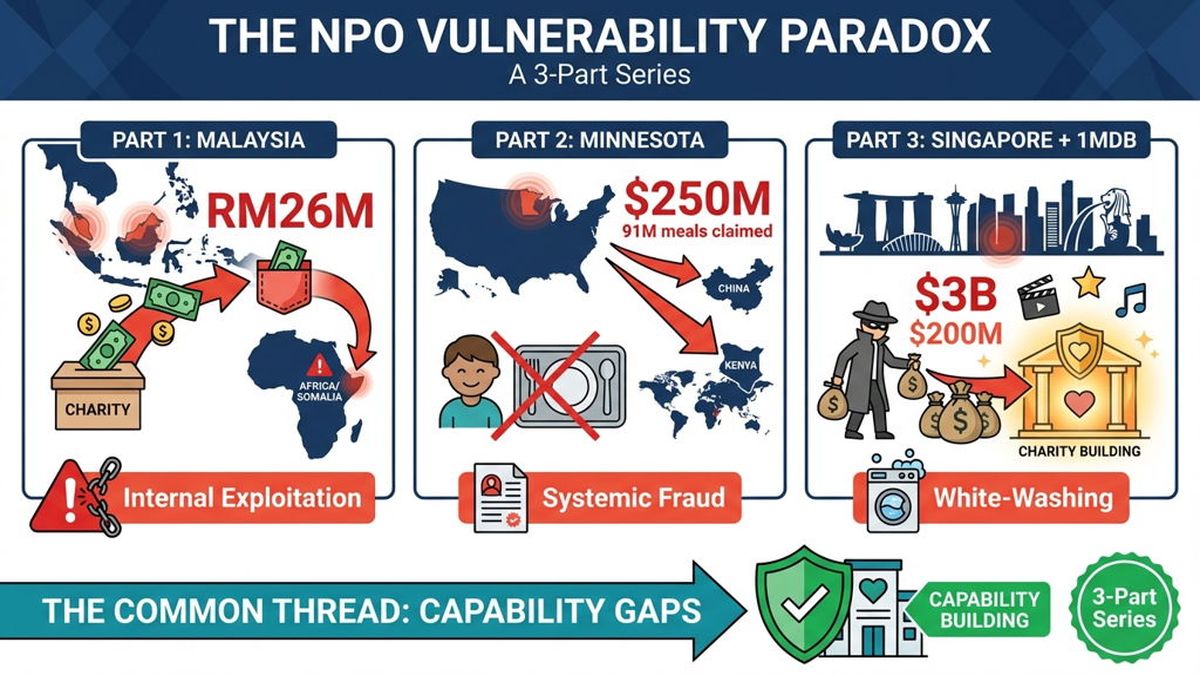
The very things that make Non-Profit Organisations powerful are what make them vulnerable.
Public trust. Cross-border reach. Diverse funding. Community access. These strengths enable NPOs to serve those who need it most. But viewed through a financial crime lens, each one becomes a potential weakness exploited by those who would use charitable organisations for harm.
This is the NPO Vulnerability Paradox. And it's at the heart of a growing crisis facing the charitable sector worldwide.
The Series
Over three parts, we examine how NPOs are being exploited from the inside and the outside, and what can be done to protect them.
[Part 1: The NPO Vulnerability Paradox](https://www.jfourthsolutions.com/post/the-2026-compliance-landscape-part-1-of-3) — When Strengths Become Weaknesses
We introduce the paradox and explore why FATF Recommendation 8 exists. Through Malaysia's recent NGO investigation where RM26 million in donations allegedly ended up in personal accounts we see how internal exploitation threatens the sector's integrity.
Key insight: "The trust that makes NPOs effective can be weaponised against them."
[Part 2: The Threat Has Evolved](https://www.jfourthsolutions.com/post/the-2026-compliance-landscape-part-2-of-3) — From Terrorist Financing to Systemic Fraud
The threat landscape has shifted beyond terrorist financing. We examine Minnesota's Feeding Our Future scandal, the largest pandemic-era fraud in the United States where $250 million was stolen through a child nutrition program. 91 million meals claimed. Almost none delivered.
Key insight: "Oversight didn't fail because the fraud was invisible. It failed because the system was ill-equipped to act on what it saw."
[Part 3: When Criminals Exploit Good Names](https://www.jfourthsolutions.com/post/the-2026-compliance-landscape-part-3-of-3) — The White-Washing Threat
What if criminals don't infiltrate NPOs but exploit them from the outside? Through Singapore's $3 billion money laundering case and Jho Low's $200 million in celebrity charity donations, we explore "white-washing" when criminals donate to legitimate charities to buy legitimacy.
Key insight: "The bigger the charity's brand, the better the cover. And most charities have no idea they're being used."
Key Takeaways
Across three continents and three very different cases, the pattern is consistent:
- The threats are evolving: from terrorist financing to internal fraud to external exploitation
- Regulation alone isn't the answer: more rules don't help if NPOs lack the capacity to implement them
- De-risking by banks punishes the wrong actors: pushing NPOs toward less transparent channels
- Capability building is the path forward: equipping NPOs with proportionate tools to protect themselves
The Path Forward
FATF's February 2025 Standards update introduced a critical shift toward proportionality, applying controls that match each organisation's actual risk profile. This is welcome news for well-governed NPOs.
But proportionality requires capability. NPOs must be able to:
- Understand their own risk exposure
- Implement proportionate controls
- Demonstrate their integrity to banks and regulators
- Detect and report suspicious activity
This isn't about turning charities into compliance departments. It's about giving them the minimum viable toolkit to protect themselves and the people they serve.
De-risking through capability building. That's the path forward.
Download our free NPO Vulnerability Checklist to see where your organisation stands, and what to fix first.
Work With Us
JFourth works at the intersection of compliance, governance, and financial inclusion. We help NPOs and social enterprises build the capability to navigate AML/CFT requirements without losing sight of their missions.
If your organisation is grappling with these challenges, get in touch. We'd love to help.