
Anti-Money Laundering
When Fraud Meets Laundering: The 60-Second Pipeline
Jan 18 · 5 min read
Part 2 of 3 - a Series on Payments and Financial Crime
She spent three months falling in love. The money disappeared in under a minute.
I keep coming back to this asymmetry. The time criminals invest in the fraud - the grooming, the manipulation, the fake platforms, versus the speed at which they move the money once they have it.
This is the new reality of financial crime. Fraud and money laundering aren't separate disciplines anymore. They're a single, integrated pipeline. And instant payments have made it devastatingly efficient.
The Anatomy of a 60-Second Cash-Out
Let me walk you through what happens:
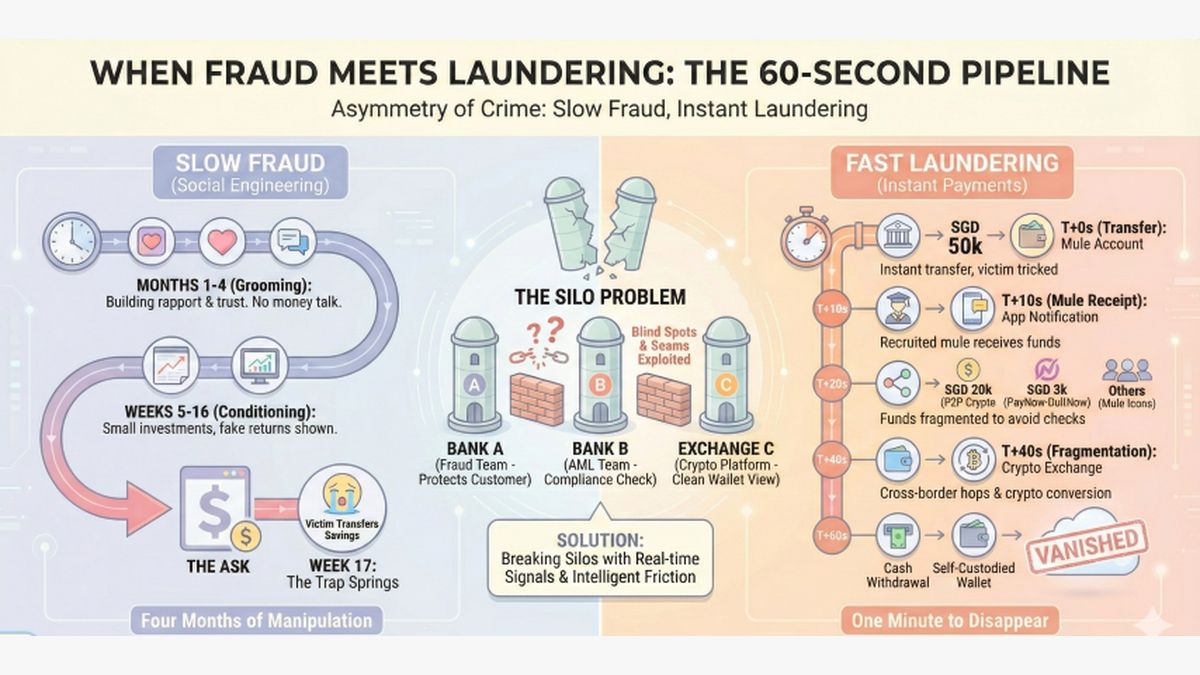
T+0 seconds: A victim in Singapore, convinced she's investing in crypto with someone she trusts, transfers SGD 50,000.
T+10 seconds: Funds hit a mule account, say... a university student recruited on Telegram for "easy money." He doesn't know where the money came from. He doesn't ask.
T+20 seconds: The funds split to avoid velocity checks. SGD 40,000 moves to a P2P crypto seller. SGD 1,000 hops to Malaysia via PayNow-DuitNow (maxing the daily limit). The rest scatters to second-tier mules.
T+40 seconds: The Malaysian funds fragment across three e-wallets. The crypto seller releases USDT to a self-custodied wallet.
T+60 seconds: The trail goes cold.
By the time the victim realises something is wrong, often weeks later, the money has crossed a dozen accounts, multiple jurisdictions, and converted to immutable code.
One minute. That's all it takes.
Mule Networks as Infrastructure
Money mules aren't new. The scale is.
Criminal syndicates now run mule networks like logistics operations. They recruit through social media, gaming platforms, and encrypted apps. They target students, job seekers, migrant workers, people who need money and have clean banking histories.
The structure is layered:
- First-tier mules: Receive funds directly from victims. Most exposed, most disposable.
- Second-tier mules: Receive fragmented funds to obfuscate the trail.
- Third-tier mules: Consolidate and cash out—often in a different country.
- Runners: Collect physical cash or crypto keys.
Each layer insulates the next. By the time investigators identify the first-tier mule, the money and the people who matter, are gone.
Singapore investigated over 9,000 people for money mule activities in 2023. Many were young. Many claimed ignorance. Some were victims themselves, coerced into participating.
The syndicates don't care. Mules are expendable. The infrastructure is what matters.
The Silo Problem
Most financial institutions have separate fraud and AML teams.
Fraud teams protect customers (preventing the outflow). AML teams ensure regulatory compliance (monitoring the flow).
The problem? The fraud victim is at Bank A. The mule account is at Bank B. The cash-out happens at an exchange in Seychelles.
No single institution sees the whole picture.
- Bank A sees an authorised transfer (the victim was socially engineered).
- Bank B sees a deposit that matches the profile (until it exits seconds later).
- The Exchange sees a clean wallet.
Criminals exploit these seams deliberately. They know the gaps better than we do.
Pig Butchering: Slow Fraud, Fast Laundering
The author agrees with [Interpol](https://www.interpol.int) and other law enforcement agencies that the term "pig butchering" (a translation of the Chinese phrase Sha Zhu Pan) is dehumanising and victim-blaming. By likening victims to livestock being "fattened for slaughter," the original term discourages people from reporting crimes due to shame and stigma. Therefore, "romance baiting" is preferred.
The most sophisticated pipelines don't rush the fraud. They rush the laundering.
Romance baiting scams where victims are "fattened" before the slaughter, exemplify this asymmetry:
- Weeks 1-4: Contact via dating app. Building rapport. No mention of money.
- Weeks 5-8: Casual mentions of investment success. Screenshots of profits.
- Weeks 9-12: Introduction to a "platform." Small investments, small returns to build trust.
- Weeks 13-16: Larger investments. The victim watches their "portfolio" grow.
- Week 17: The ask. A major opportunity. The victim transfers their life savings.
- Week 17 + 60 seconds: The money is gone.
Four months of social engineering. One minute of instant payments. This is why the laundering window is the critical choke point. It is the only time the criminals are vulnerable.
What Needs to Change
Stopping these pipelines requires breaking down silos—within institutions and across them.
- Real-time, Cross-Institutional Signals — The victim's bank sees an unusual transfer. The receiving bank sees sudden inflows to a dormant account. A third bank sees rapid fragmentation. Individually, weak signals. Together, unmistakable. We need the infrastructure to connect them in milliseconds, not days.
- Behavioural Analytics at the Mule Layer — Mule accounts have patterns: dormancy followed by sudden high-velocity activation. Funds in and immediately out. No merchant spend. These patterns are detectable if we look for them.
- Intelligent Friction — A 15-minute delay on a first-time high-value transfer could break the 60-second pipeline. Singapore's new 24-hour cooling period for high-risk transfers is a step in the right direction. It applies friction based on risk, giving the victim the one thing they desperately need: time.
The Bottom Line
Fraud and money laundering have merged into a single, optimised pipeline. Criminals have industrialised their operations and studied our gaps.
Instant payments didn't create this problem. But they've shrunk the intervention window to almost nothing.
The institutions that will succeed are those that stop treating fraud and AML as separate functions. That invest in real-time signals and cross-ecosystem intelligence. That accept collaboration isn't optional.
In a world where crime moves in 60 seconds, silos are a luxury we can't afford.
This is Part 2 of our series on Payments and Financial Crime. Part 3 will explore what "Safety by Design" looks like across this fragmented landscape—and the regulatory, technical, and cultural shifts required to build it.
JFourth works at the intersection of compliance, technology, and financial inclusion, helping organisations build frameworks that protect the financial system while enabling innovation. Get in touch to learn more.