
Anti-Money Laundering
AML for Casinos and Gaming: Where Cash Meets Compliance
Mar 22 · 6 min read
Previously: Part 6 - AML for High-Value Dealers: Precious Metals, Stones, Luxury Goods & Pawn Shops
The $450 Million Lesson
$450 million. That's what Crown Resorts paid for failing to stop money laundering at its Melbourne and Perth casinos.
The Federal Court found Crown had committed at least 546 breaches of Australia's AML/CTF Act. High-risk gamblers with links to organised crime moved tens of billions through VIP rooms. Junket operators with alleged connections to criminal syndicates continued operating for years. And $23 million in suspicious cash transactions in a single private gaming room went unchecked.
The judge called Crown's conduct "systemic, longstanding and egregious."
Crown isn't alone. In 2025, Caesars Palace was fined $7.8 million after allowing an illegal bookmaker to gamble for years despite knowing he had no legitimate source of funds. Resorts World paid $10.5 million for similar failures. MGM Grand and The Cosmopolitan settled for $7.45 million. (It's worth noting that MGM Resorts did later pay a separate $8.5 million fine in 2025 related to the Mathew Bowyer case).
The pattern is clear: casinos are high-risk environments for money laundering, and regulators are finally paying attention.
Why Criminals Love Casinos
Casinos offer criminals something rare: a legitimate explanation for large amounts of cash.
Walk into a bank with $100,000 in cash and you'll face questions. Walk into a casino with the same amount and you're a valued customer.
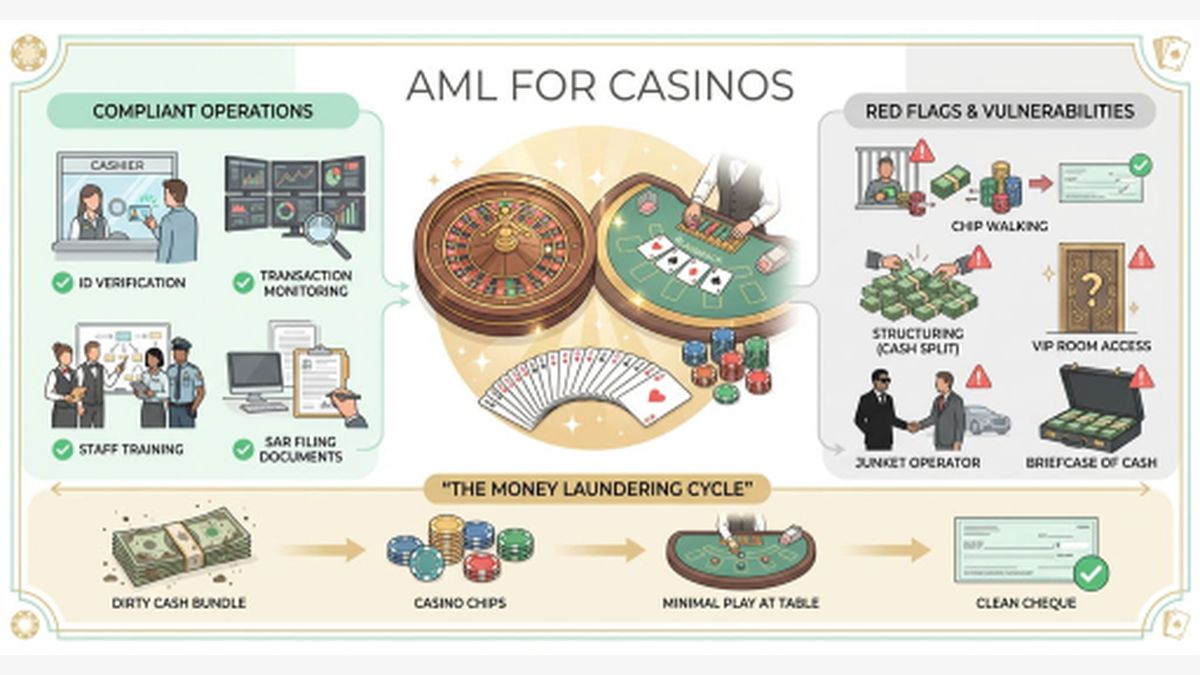
| What Casinos Offer | Why Criminals Value It | | ------------------------------ | ----------------------------------------------------------------- | | Cash-intensive environment | Large cash transactions are normal, not suspicious | | Conversion mechanism | Cash becomes chips becomes cheque - a paper trail of "winnings" | | Speed | Money can be "cleaned" in hours, not weeks | | Plausible explanation | "I won it gambling" explains sudden wealth | | VIP discretion | High-rollers expect privacy and criminals exploit it |
The Methods
Chip walking: A criminal walks in with $100,000 in drug proceeds. They buy chips, play a few hands, lose a small amount, then cash out. The casino issues a cheque for $95,000. The money is now "clean."
Structuring: Making multiple transactions just below reporting thresholds. A customer who buys $9,000 in chips multiple times a day is structuring, even if each transaction is technically compliant.
Junket operations: Third-party operators move money across borders under the guise of facilitating high-roller gambling. The junket handles the money; the casino provides the venue; the source of funds remains obscure.
Third-party cash-outs: Someone other than the player cashes out chips or collects winnings — breaking the chain of identification.
The Junket Problem
Junkets create layers of opacity between the casino and the ultimate source of funds. The casino sees the junket. The junket sees the player. But the casino often doesn't see the player's source of funds.
Many jurisdictions have now banned or restricted junket operations:
- Macau effectively ended its junket system in 2022 following the arrest of junket operator Alvin Chau on money laundering charges
- Australia imposed strict licensing requirements following the Crown inquiry
- Philippines tightened regulations on junket operators
The direction is clear: the opacity that junkets provide is no longer acceptable.
Case Study: Caesars Palace - Ignored Warnings
The Caesars case illustrates how red flags accumulate without action.
The customer: Mathew Bowyer, later convicted as an illegal bookmaker operating a $100 million sports betting operation.
The warnings:
- Multiple due diligence checks failed to identify a legitimate income source
- An anonymous caller specifically identified him as a "bookie"
- His gambling patterns were inconsistent with any legitimate occupation
The response: His account was suspended, reviewed, and repeatedly reinstated. He continued gambling at Caesars for years.
The outcome: $7.8 million fine. Regulatory action. Reputational damage.
The lesson: Red flags aren't suggestions. They're obligations.
Red Flags: What Should Trigger Scrutiny
Customer Red Flags
🚩 Reluctance to provide identification
🚩 No apparent legitimate source of wealth
🚩 Known or suspected criminal connections
🚩 PEP status without enhanced scrutiny
🚩 Inconsistent gambling behaviour relative to stated occupation
Transaction Red Flags
🚩 Structuring - transactions just below reporting thresholds
🚩 Minimal play relative to buy-in (buying $100k, cashing out $95k)
🚩 Third-party cash-outs
🚩 Chip-to-cheque conversion without significant play
🚩 Unusual win/loss patterns between related players
Behavioural Red Flags
🚩 Indifference to winning or losing
🚩 Excessive tipping or staff befriending
🚩 Requests to avoid recording transactions
🚩 Nervousness or surveillance awareness
The Human Cost
Behind every money laundering case are real victims.
The money being laundered comes from somewhere - drug trafficking, human exploitation, fraud, organised crime. Every dollar laundered through a casino represents harm inflicted on someone.
The Crown inquiry revealed customers who gambled for days without sleep, who lost millions they couldn't afford, who were extended credit they could never repay. The same VIP programmes that attract criminals attract problem gamblers.
When casinos fail their gatekeeper obligations, organised crime groups use those funds to expand operations. More trafficking. More exploitation. More harm extending far beyond the gaming floor.
What Casinos Can Do Today
1. Know your customer ... really know them A customer buying $50,000 in chips should explain their source of funds. "I'm a businessman" isn't an explanation - it's a category.
2. Monitor transactions holistically A customer who buys $9,000 in chips once is below threshold. Three times in one day is structuring. Daily for a week is a laundering operation. Patterns reveal the truth.
3. Train and empower staff Front-line employees see red flags first. They need to know what to look for, how to escalate, and that they won't be punished for flagging a high-value customer.
4. Scrutinise VIP programmes Enhanced due diligence isn't optional for VIPs — it's essential. If a VIP can't document source of wealth, they shouldn't be in your programme. The revenue isn't worth the liability.
5. Report suspicious activity When in doubt, file a SAR. The consequences of under-reporting are severe. The consequences of over-reporting are minimal.
6. Document everything When regulators review your files, they're looking for evidence of thought, not just completed forms.
The PULSE Framework for Casinos
P - Purpose You're not just providing entertainment. You're controlling access to a system that transforms illicit cash into legitimate funds. Revenue generation cannot override gatekeeper obligations.
U - Unified Standards Apply the same rigour to every customer, regardless of value. The high-roller deserves scrutiny, not exemption.
L - Leadership Foster a culture where compliance is celebrated, not circumvented. When a cage operator flags a suspicious transaction, they should be thanked, not questioned.
S - Screening Screen customers against sanctions lists and PEP databases. Monitor for structuring and minimal-play laundering. Verify source of funds for high-value players.
E - Evidence Document your reasoning. If you investigated and concluded a customer was legitimate, record why. If you identified red flags and took action, document the process.
The Bottom Line
Casinos are gatekeepers. You control access to a system that can transform illicit cash into legitimate funds in hours.
The Crown case: $450 million fine. Years of criminal activity flowing through gaming floors unchecked.
The Caesars case: $7.8 million fine. Years of ignored warnings about an obviously suspicious customer - because he was valuable.
The pattern is consistent:
- Red flags identified but not acted upon
- VIP revenue prioritised over compliance
- Culture of accommodation rather than scrutiny
The regulatory response is equally consistent: larger fines, individual accountability, licence reviews.
This series focused on traditional casinos, but online gaming presents its own emerging frontier. Crypto casinos, cross-border platforms, and anonymous accounts create new vulnerabilities that regulators are only beginning to address. That's a topic for another day, but the direction of travel is clear.
The vision: A gaming industry where VIP programmes enhance due diligence rather than bypass it. Where front-line staff are empowered to flag concerns about any customer. Where compliance is seen as protecting the business, not hindering it.
It takes a network to defeat a network.
The criminals who exploit casinos have networks - advisors who identify weak controls, junkets who facilitate access, associates who help structure transactions.
The defence needs networks too. Casinos sharing typologies. Regulators providing guidance. Compliance professionals building cultures that resist exploitation.
That's how we close the gatekeeper gap.
This concludes The Gatekeeper Gap series.
Coming Next: The Complete Guide to AML for DNFBPs - bringing together all seven parts with additional frameworks and resources
Related Reading:
𝗙𝗔𝗧𝗙 𝗥𝗲𝘀𝗼𝘂𝗿𝗰𝗲𝘀: