
Anti-Money Laundering
AML for Trust and Company Service Providers: The Architecture of Anonymity
Mar 2 · 7 min read
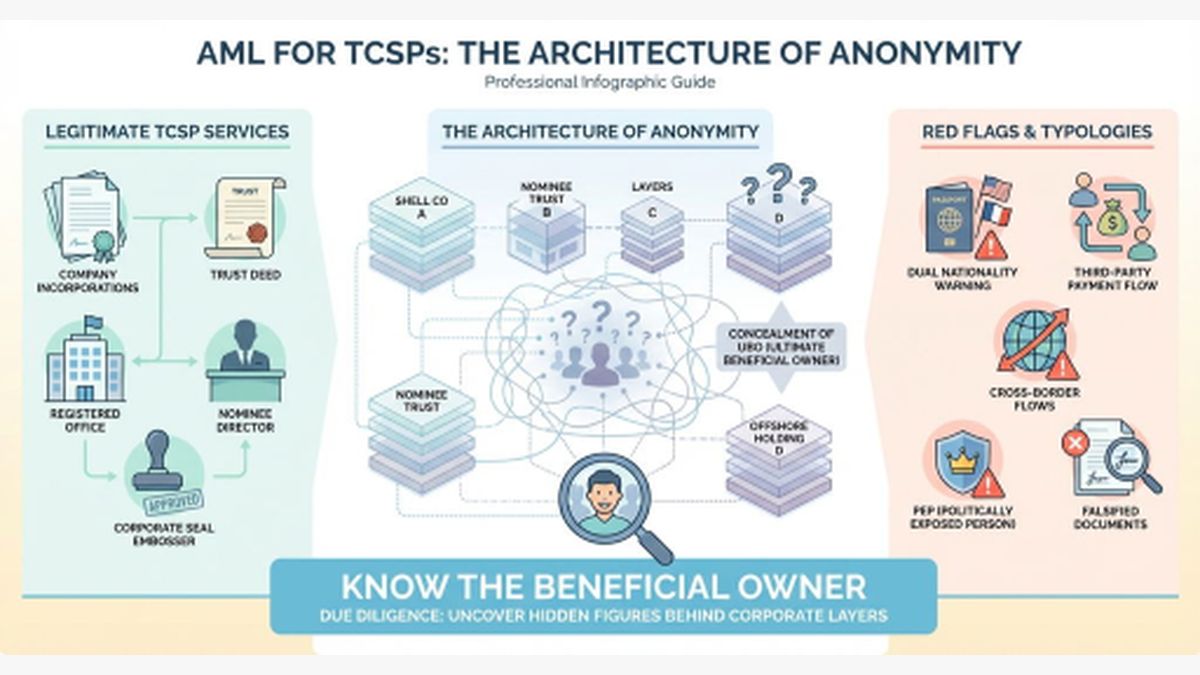
Part 4 of 7: The Gatekeeper Gap Series
Previously: [Part 3 - AML for Lawyers: When Legal Privilege Meets Financial Crime Prevention](https://www.jfourthsolutions.com/post/aml-for-lawyers-when-legal-privilege-meets-financial-crime-prevention)
The £100 Laundromat
A single UK formation agent created over 2,000 companies used in fraud schemes.
Total fraud: billions. Fee per company: £100.
The corporate structures that enabled global financial crime cost less than a restaurant meal.
Shell companies. Nominee directors. Complex trusts. Multi-jurisdictional structures.
These aren't inherently criminal tools. In the right hands, they serve legitimate purposes - estate planning, asset protection, business structuring. In the wrong hands, they become the architecture of anonymity.
Trust and Corporate Service Providers (TCSPs) sit at the centre of this tension. They create and administer the structures that can either enable or prevent financial crime.
As we move deeper into 2026, the message from global regulators is clear: the honeymoon period is officially over.
Why Criminals Need TCSPs
Banks have compliance departments. They file suspicious transaction reports. They ask questions.
But a shell company? It asks nothing. It remembers nothing. It exists only on paper - a legal fiction that can open bank accounts, sign contracts, own property, and move money across borders.
Criminals don't need to hack the bank if they can walk through the front door of a corporate service provider.
| Service | Legitimate Purpose | Criminal Exploitation | | -------------------------- | -------------------------------------------- | ------------------------------------------ | | Company incorporation | Business formation, liability protection | Creates entities to hold illicit assets | | Nominee directors | Privacy, administrative convenience | Conceals the true beneficial owner | | Nominee shareholders | Confidentiality in sensitive transactions | Hides ownership of criminal proceeds | | Trust administration | Estate planning, asset protection | Obscures ownership across jurisdictions | | Registered office | Legal address requirement | Creates illusion of legitimate presence | | Virtual office services | Cost-effective business presence | Facade of substance where none exists |
The services seem administrative. But they are foundational.
When a TCSP incorporates a company and provides a nominee director, they create an entity that can open bank accounts, sign contracts, own real estate, and transfer funds internationally, all while the true beneficial owner remains invisible.
The Regulatory Landscape
Under FATF's 5th Round of Mutual Evaluations (2024–2030), the question has shifted from "Do you have the laws?" to "Do those laws actually work?"
| Jurisdiction | Key Developments | Impact on TCSPs | | ------------------- | --------------------------------------------------------------------------------------------------------------------------------------------------------- | ------------------------------------------------ | | FATF Global | 5th Round emphasises effectiveness over technical compliance; 3-year deadline to fix deficiencies or face Grey List | Scrutiny is now constant, not periodic | | UK | Economic Crime and Corporate Transparency Act 2023 — Companies House can now verify identities, reject suspicious filings, share data with law enforcement | Era of anonymous UK company formation ending | | EU | 6th Anti-Money Laundering Directive; beneficial ownership registries strengthened; AMLA (new EU AML Authority) operational 2025 | Harmonised supervision across member states | | Singapore | Enhanced ACRA verification; stricter nominee director rules post-S$3B case | Heightened scrutiny on complex structures |
FATF's July 2024 Horizontal Review of Gatekeepers delivered a damning verdict: seven member jurisdictions representing more than half of the world's GDP scored below 50% on gatekeeper compliance.
This isn't a developing-world problem. It's a global one.
Case Studies: When the Architecture Fails
Singapore's S$3 Billion Case (2023)
Ten foreign nationals. Over S$3 billion in assets seized. More than 200 properties. Luxury vehicles, jewellery, gold bars, cryptocurrency.
The money was "cleaned" through corporate layers before it ever triggered a banking alert. Properties were owned by companies. Companies were owned by other companies. Beneficial owners hid behind layers of nominees.
The TCSP connection: By the time banks saw the transactions, the money appeared legitimate. The laundering had already happened at the TCSP level.
The UK Formation Agent Scandal
The Organised Crime and Corruption Reporting Project documented how a single formation agent created over 2,000 companies used in fraud schemes totalling billions.
These weren't sophisticated criminals seeking corrupt providers. They were simply exploiting a system that prioritised speed and volume over due diligence.
The lesson: Volume is not a defence. Every company you form can become a vehicle for crime.
The Pandora Papers (officially released 2021)
11.9 million documents. 14 offshore service providers. 35 current and former world leaders exposed.
The leak documented how TCSPs helped politicians, public officials, and wealthy individuals create opaque structures to hide assets, evade sanctions, and obscure conflicts of interest.
The aftermath: Beneficial ownership registry reforms accelerated globally. The opacity that TCSPs once provided is becoming harder to maintain and harder to justify.
Red Flags: What Should Trigger Scrutiny
Client Red Flags
- Reluctance to provide identification or beneficial ownership information
- Uses intermediaries unnecessarily or refuses direct contact
- Stated business purpose is vague or inconsistent
- Unusually knowledgeable about reporting thresholds
- PEP connections without credible explanation
- Multiple passports or recently acquired citizenship-by-investment
- Source of wealth unclear or inconsistent with profile
Structure Red Flags
- Complex multi-jurisdictional structures with no commercial rationale
- Nominee arrangements without legitimate privacy needs
- Circular ownership (Company A owns B owns C owns A)
- Requests for "aged" or "shelf" companies with existing bank accounts
- Structures designed to obscure rather than facilitate legitimate business
- Trust structures with vague or circular beneficiary definitions
Transaction Red Flags
- Payments from unconnected third parties
- Funds from jurisdictions inconsistent with stated business
- Requests to move funds rapidly through the structure
- Round-sum transactions inconsistent with normal business patterns
- Reluctance to provide source of funds documentation
The UBO Challenge: Where Most TCSPs Fail
Identifying the Ultimate Beneficial Owner is the critical control and the most commonly failed.
Why it's hard:
| Challenge | Example | | ----------------------------- | --------------------------------------------------------------------------------------------- | | Layered structures | Trust in Jersey → owns company in BVI → owns company in Delaware → owns London property | | Nominee arrangements | Legal owner is a nominee; beneficial owner is undisclosed | | Name variations | محمد becomes Mohammed, Mohamed, Muhammad, Mohamad | | Multiple nationalities | Client presents EU passport; holds undisclosed second nationality from sanctioned country | | Circular ownership | No single entity sits at the top of the chain | | Discretionary trusts | Beneficial owner is a "moving target" among a class of potential beneficiaries |
Why name screening matters:
A sanctions screening that only checks "Mohammed Al-Rahman" will miss "Mohamed Alrahman," "M. Rahman," or the Arabic original. Criminals know this. They exploit transliteration variations, truncated names, and spelling inconsistencies.
Effective UBO verification requires:
- Screening all name variations and transliterations
- Checking all nationalities (not just the passport presented)
- Screening family members and close associates for PEP connections
- Ongoing monitoring — not just onboarding checks
- Documentation that proves you did the work
If you can't identify the UBO with confidence, you shouldn't create the structure.
The PULSE Framework for TCSPs
P - Purpose: Move beyond box-ticking. Understand that every structure you create either enables or prevents financial crime. There is no neutral ground.
U - Unified Standards: Apply the same rigour to every structure, regardless of fee level or client relationship. The £500 formation gets the same due diligence as the £50,000 trust.
L - Leadership: Senior management must own compliance, not delegate it. They must create a culture where declining high-fee, high-risk clients is supported, not punished.
S - Screening: This is where TCSPs most often fail. Require disclosure of all nationalities. Screen all name variations. Monitor continuously, not just at onboarding.
E - Evidence: Verify source of wealth independently. Don't rely solely on client declarations or intermediary assurances. If you can't document it, it didn't happen.
The Capacity Gap - And How to Close It
Here's the uncomfortable truth: a small corporate secretarial firm doesn't have a compliance department.
One person might handle formations, filings, registered office services, and compliance — all at once. No transaction monitoring software. No dedicated MLRO. Perhaps never read FATF Recommendation 22.
But they're creating entities that can move millions across borders.
What small TCSPs can do today:
- Know the UBO - not just the intermediary. "My client prefers to remain confidential" is not an acceptable answer.
- Understand the purpose. Every structure should have a legitimate rationale that can be articulated clearly. "Asset protection" isn't enough. Protection from what?
- Screen properly. Check all name variations. All nationalities. PEP status extends to family members.
- Document everything. If you can't prove you did due diligence, you didn't do due diligence.
- Be willing to say no. The short-term revenue isn't worth the long-term consequences.
The Human Cost
Behind the shell companies and nominee directors are real victims.
When a government minister loots public funds and hides them in offshore structures, schools don't get built. When criminals use shell companies to run investment scams, real people lose their retirement savings. When structures circumvent sanctions, authoritarian regimes are strengthened.
The corporate structures are abstract. The suffering they enable is not.
That's what AML for TCSPs is really about. Not paperwork. Not box-ticking. But refusing to build structures that serve criminals at the expense of victims.
Closing the Gap
TCSPs are the architects of the corporate world.
A shell company formed without adequate due diligence can open bank accounts, own property, and move money, all while hiding the criminal behind it.
The structures are legal. The uses may not be.
It takes a network to defeat a network.
The TCSP who asks one more question. The formation agent who declines the suspicious client. The trust administrator who verifies source of wealth.
That's how we close the gatekeeper gap.
Ready to build a compliance culture that protects and empowers?
This is Part 4 of our DNFBP series.
Coming Next: Part 5: AML for High-Value Dealers - Precious Metals, Stones, Luxury Goods & Pawn Shops
Related Reading:
FATF Resources: