
Anti-Money Laundering
The NPO Vulnerability Paradox: When Strengths Become Weaknesses
Jan 13 · 5 min read
Part 1 of a 3-Part Series on Protecting Non-Profit Organisations Through Capability Building
The very things that make Non-Profit Organisations powerful are what make them vulnerable.
This paradox sits at the heart of one of the most pressing challenges facing the charitable sector today. NPOs exist to do good, to serve communities, respond to crises, and channel generosity toward those who need it most. Yet these same qualities make them attractive targets for exploitation by those who would use them for harm.
At JFourth, we've seen this firsthand. Through our training and advisory work with NPOs across the region, we've learned how different it is to operate with limited funds, lean teams, and missions that demand trust. Most NPOs run incredibly lean, yet they're expected to meet the same compliance standards as well-resourced corporations.
The result? A vulnerability gap that criminals are increasingly learning to exploit.
The Paradox Explained
Consider what makes an NPO effective:
- Public trust and goodwill: People donate because they believe in the cause
- Cross-border operations: Reaching those in need, wherever they are
- Diverse funding sources: From individual donors to corporate sponsors to government grants
- Cash-intensive activities: Especially in underserved or crisis-affected areas
- Deep community access: Embedded relationships that formal institutions can't replicate
Now look at that same list through a financial crime lens. Every single strength becomes a potential vulnerability:
- Trust can be exploited by those seeking legitimacy
- Cross-border operations create complexity that obscures fund flows
- Diverse funding makes source verification challenging
- Cash intensity reduces traceability
- Community access can be leveraged to move funds undetected
This is precisely why FATF Recommendation 8 exists, to address the risk of NPOs being misused for terrorist financing and, increasingly, for money laundering and fraud.
Case Study: Malaysia's NGO Investigation
In January 2026, the Malaysian Anti-Corruption Commission (MACC) announced that at least three "popular" NGOs face legal action for allegedly misappropriating millions in donations.
According to MACC Chief Commissioner Tan Sri Azam Baki, these organisations took advantage of the generosity of Malaysians to accrue "illegal assets" and wealth for themselves.
His words were clear: "They 'ride' on religion, collecting millions in cash, but the funds go into the personal account of their chairman."
The scale is sobering. In mid-2025, MACC arrested several leaders of an NGO for allegedly conspiring to misappropriate funds belonging to the organisation. Some RM26 million in public donations was allegedly siphoned by the NGO's committee members, including its chairman.
But what struck us most was Azam's criticism of the oversight gap: "The relevant departments need to be aware of what's happening. Certain ministries need to monitor and keep their eyes open for suspicious activities among NGOs."
This isn't just a failure of individuals. It's a systemic vulnerability, one that exists because the very trust we place in charitable organisations can be weaponised against the people they're meant to serve.
Why FATF Recommendation 8 Matters
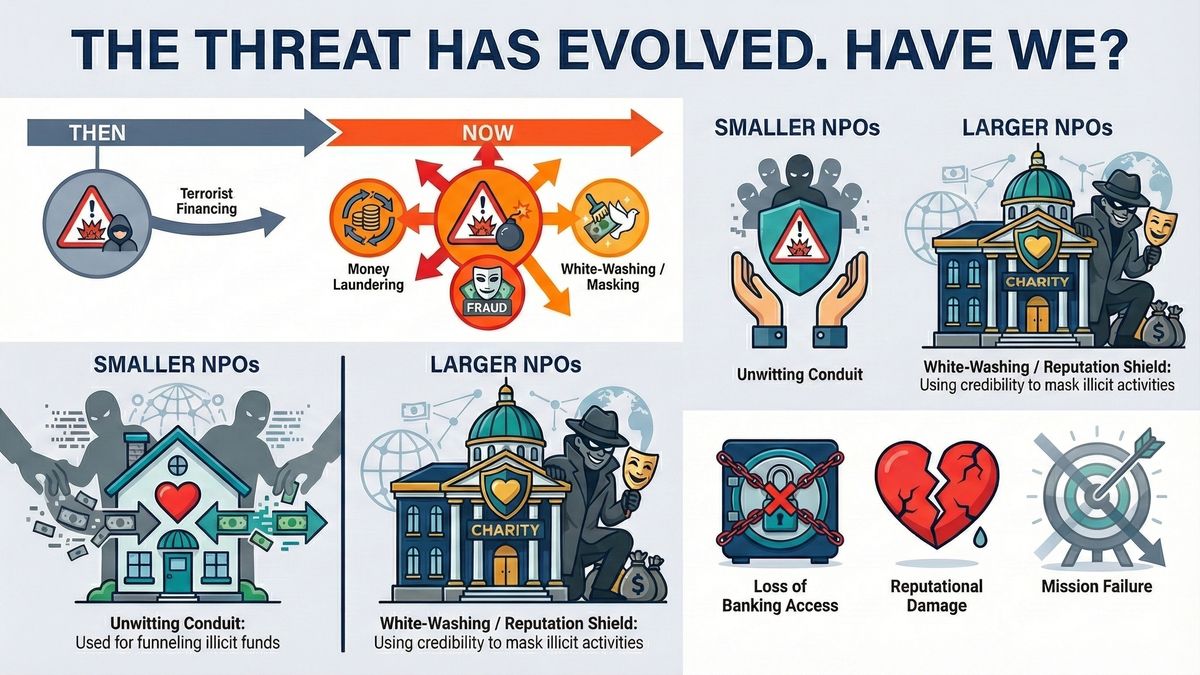
The Financial Action Task Force (FATF) recognised this vulnerability decades ago. Recommendation 8 specifically addresses the risk that NPOs may be misused for terrorist financing. But the threat has evolved.
Historically, the primary concern was that NPOs operating in conflict zones or with cross-border fund flows could be exploited — wittingly or unwittingly — to channel funds to terrorist organisations. That risk remains real.
But today, we're seeing a troubling expansion:
- Internal exploitation: NPO leaders misappropriating funds meant for beneficiaries (as in the Malaysia case)
- External exploitation: Criminals using NPOs as conduits for money laundering or as vehicles for "white-washing" their reputations
- Systemic fraud: Large-scale schemes that exploit programmes designed to help the vulnerable
The February 2025 FATF Standards update introduced a critical shift: from "commensurate" to "proportionate" controls. This means applying the right level of scrutiny based on the nature of the risk, not blanket, one-size-fits-all approaches that burden low-risk organisations while missing high-risk ones.
For NPOs, this is both an opportunity and a challenge. Proportionality means that well-governed, low-risk NPOs shouldn't face the same friction as high-risk entities. But it also means that NPOs must be able to demonstrate their risk profile - something many lack the capacity to do.
The De-Risking Problem
Here's the cruel irony: when banks can't distinguish well-governed NPOs from compromised ones, they often choose to avoid the sector entirely.
This phenomenon, known as "de-risking", has devastating consequences. Legitimate NPOs lose access to the financial system. They can't receive donations, pay staff, or transfer funds to beneficiaries. Their missions grind to a halt.
De-risking doesn't reduce risk. It just pushes NPOs toward less transparent channels e.g. informal transfers, cash-based operations, intermediaries, which actually increases the very vulnerabilities regulators are trying to address.
The FATF has explicitly warned against this. The 5th Round of Mutual Evaluations emphasises that de-risking is not an acceptable risk management strategy. But for banks facing regulatory pressure and limited resources, it often feels like the safest option.
The Path Forward: Capability Building
This is where we believe the real solution lies.
Regulation alone isn't the answer. More rules won't help if NPOs lack the capacity to implement them. And blanket de-risking punishes the good actors while doing little to stop the bad ones.
What's needed is capability building, equipping NPOs with the knowledge, tools, and governance frameworks to:
- Understand their own risk exposure
- Implement proportionate controls
- Demonstrate their integrity to banks and regulators
- Detect and report suspicious activity
This isn't about turning charities into compliance departments. It's about giving them the minimum viable toolkit to protect themselves — and in doing so, making them safer partners for the financial system.
De-risking through capability building. That's the path forward.
What's Next
This is Part 1 of our 3-part series on the NPO Vulnerability Paradox. In Part 2, we explore how the threat has evolved beyond terrorist financing into systemic fraud.
Read the full series, then download our free NPO Vulnerability Checklist to assess your organisation's defences.
The threat is bigger than most NPOs realise. But understanding it is the first step toward building resilience.
JFourth works at the intersection of compliance, governance, and financial inclusion, helping organisations, including NPOs, build the capability to protect themselves and the people they serve. Get in touch to learn more about our training and advisory services.