
Industry Trends
"The Tide Is Turning: A Whole-of-Society Response to Financial Crime"
Jan 19 · 7 min read
Part 4 - Wrap Up of a Series on Payments and Financial Crime
For three parts of this series, we painted a grim picture.
The 60-second pipeline. Fragmented ecosystems. Compliance theatre. Criminals with network effects while we operate in silos.
But here's what we didn't tell you: the tide is turning.
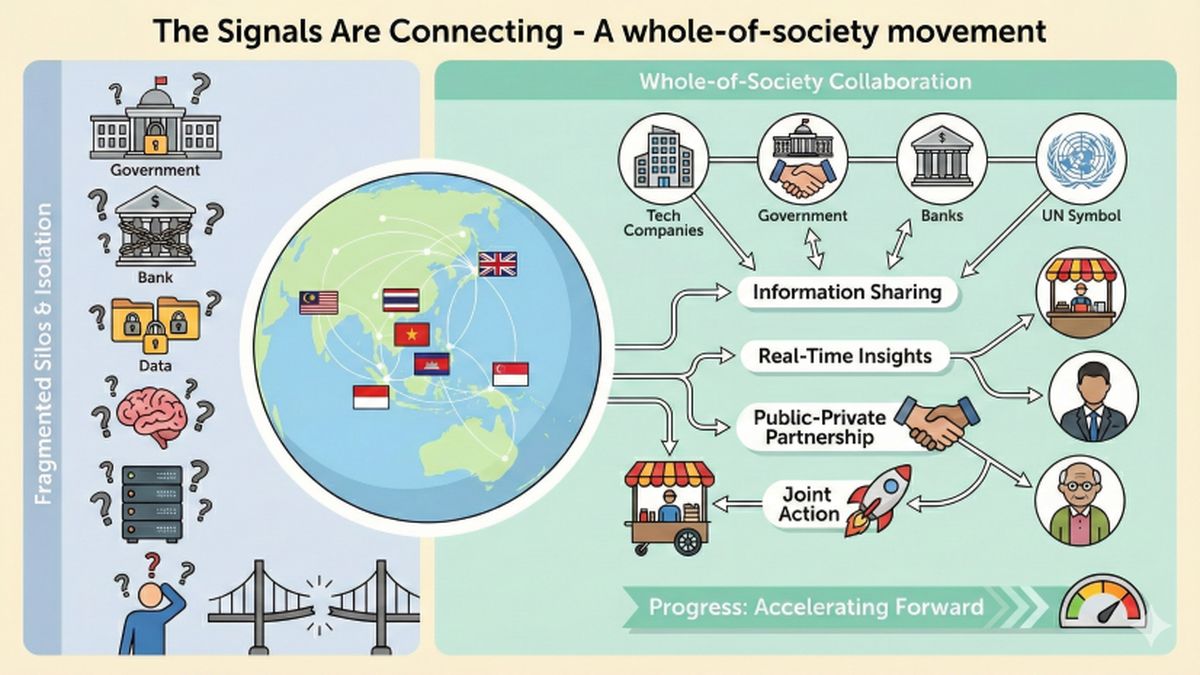
And it's not just governments and banks. It's a whole-of-society movement.
The Global Signal Exchange
In October 2024, something quietly significant happened.
Google, the Global Anti-Scam Alliance (GASA), and the DNS Research Federation launched the Global Signal Exchange (GSE), a global clearinghouse for scam and fraud signals.
The ambition? Slash online fraud by half within a decade.
Here's why this matters:
- 70+ million signals and growing
- Data providers include Google, Amazon, Meta, Spamhaus
- Supporters include Microsoft, GovTech Singapore, Crime Stoppers International
- Allies include UNODC and the Global Anti-Scam Alliance
- AI-powered pattern matching at internet scale
For the first time, tech giants and infrastructure providers are sharing threat intelligence across industries. Not just within sectors, but across them.
This is what collaboration infrastructure looks like.
The Hanoi Convention: A Global Framework Emerges
In December 2024, the UN General Assembly adopted the Convention against Cybercrime—the first comprehensive global treaty on the subject.
In October 2025, 72 countries gathered in Hanoi to sign it.
The Convention:
- Criminalises cyber-dependent and cyber-enabled offences (including online fraud)
- Facilitates cross-border sharing of electronic evidence
- Establishes a 24/7 cooperation network among states
- Creates frameworks for mutual legal assistance and extradition
It's not perfect. Human rights groups have raised concerns about surveillance provisions. Many countries have not signed yet. Implementation will be uneven.
But for the first time, there's a universal legal framework for pursuing scammers across borders. That matters!
The Convention enters into force 90 days after 40 countries ratify it. Given the momentum, that could happen faster than expected.
Snapshot
Here's a snapshot of how different jurisdictions are tackling the same problem with different tools:
- Singapore's Shared Responsibility Framework: Banks and telcos now accountable, with real-time fraud surveillance mandated.
- Malaysia's National Fraud Portal: Automated cross-bank fund tracing; over RM72 million frozen.
- Australia's Scam-Safe Accord: $100 million investment; shared fraud intelligence through AFCX.
- Thailand's AOC: National hotline, border enforcement, and infrastructure cutoffs to scam compounds
- UK's Mandatory Reimbursement: A world-first liability shift for APP fraud victims.
Each is a national solution. But together? They're the building blocks of something bigger.
Beyond Banks: The Whole-of-Society Challenge
The 60-second pipeline doesn't just run through banks. It runs through:
- Real estate agents: High-value transactions, often cash.
- Lawyers and accountants: Creating structures that obscure beneficial ownership.
- Dealers in precious metals: Cash-intensive, hard to trace.
- Casinos: Layering paradise.
- Company service providers: Shell companies on demand.
These are the Designated Non-Financial Businesses and Professions (DNFBPs), and FATF has been warning about them for years.
In Australia, a Senate inquiry confirmed what AUSTRAC had long warned: that the lack of 'Tranche 2' laws allowed billions to be laundered through real estate. In the US, FinCEN found that over 50% of suspicious real estate transactions involved politically exposed persons using shell companies.
But it goes even further.
Think about the street pedlar in Indonesia selling top-up vouchers. The convenience store in the Philippines offering remittance services. The mobile money agent in Cambodia who doesn't ask questions.
Financial crime doesn't just exploit the formal economy. It exploits the informal one too.
A whole-of-society response means:
- Banks AND DNFBPs
- Fintechs AND telcos
- Regulators AND platforms
- Formal economy AND informal economy AND NPOs
No one is too small to be part of the solution. Or too small to be exploited.
The Forgotten Piece: Victim Support
Here's what we rarely talk about: financial crime isn't just about prevention. It's about recovery.
According to GASA estimates, Malaysia faced an economic impact of RM 54 billion from scams in 2024, equivalent to 3% of the nation's GDP. Here's the scary part: 70% of victims didn't report it.
Why? Shame.
The psychological toll of being scammed goes far beyond the financial loss. Victims experience self-blame, isolation, depression, and in severe cases, suicidal ideation. They withdraw from family and friends precisely when they need support most.
In Singapore, organisations like TOUCH Mental Wellness now offer counselling specifically for scam victims, helping them process the trauma and rebuild self-esteem.
Credit Counselling Singapore (CCS) has seen over 200 debt-laden scam victims since 2023, and the numbers are rising. These are people who didn't just lose their savings. They borrowed more trying to recover their losses, and now face crushing debt.
AMP Singapore's Debt Advisory Centre reports that 15% of their cases are now scam-related, up from just 5% in 2023.
A whole-of-society approach must include victim recovery, not just prevention. We can't fight financial crime while leaving the wounded behind.
What Still Needs to Happen
Progress is real. But gaps remain:
- Cross-border signal sharing: The GSE is a start. But financial institutions need to connect to these signals, not just tech platforms. When a mule account is flagged in Singapore, Malaysia's banks should know within seconds, not days.
- Harmonised liability: Singapore's SRF, UK's reimbursement rules, Australia's Scam-Safe Accord—they're all different. Criminals exploit these inconsistencies. We need interoperability, not just inspiration.
- DNFBP and NPO inclusion: Most AML frameworks still focus on banks. Real estate, legal services, precious metals and NPOs, these sectors need the same rigour.
- Capacity building for the tail end: Big banks can build fraud surveillance systems. What about regional e-wallets? Credit unions? The weakest link determines the chain's strength.
- Ratification of the Hanoi Convention: 72 signatures is a start. 40 ratifications triggers entry into force. The faster this happens, the faster cross-border cooperation becomes legally binding.
The Opportunity for Solution Providers
If you're building in this space, here's the whitespace:
- Integration layers that connect national fraud platforms to global signal exchanges.
- Risk-based friction tools deployable across ecosystems, not just within institutions.
- Graph analytics that work across borders and asset classes.
- DNFBP and NPO focused solutions and capacity building
- Victim support platforms connecting those affected with counselling and debt advisory.
The winners won't be those with the best point solution. They'll be those who connect the pieces.
The Bottom Line
A year ago, I would have said we're losing this fight.
Today? I'm cautiously optimistic.
The signals are connecting. The frameworks are emerging. The collaboration infrastructure is being built.
A global treaty now exists. And finally, finally ...we're starting to talk about the people left behind.
Financial crime is global. The stories are local. And for the first time, the solutions are starting to match the scale of the problem.
The grandmother in Penang who lost her retirement to a love scam. The business owner in Bangkok whose supplier payments were intercepted. The student in Singapore who became a mule without understanding the consequences. The street vendor in Jakarta who unknowingly became part of the pipeline.
Their stories drove this series. Their protection is why this work matters.
If you're building, regulating, or fighting in this space, let's keep talking. The next chapter is being written now.
This concludes our four-part series on Payments and Financial Crime. Thank you for reading.
JFourth works at the intersection of compliance, technology, and financial inclusion, helping organisations build frameworks that protect the financial system while enabling innovation. Get in touch to learn more.