Anti-Money Laundering
The Threat Has Evolved: From Terrorist Financing to Systemic Fraud
Jan 13 · 6 min read
Part 2 of a 3-Part Series on Protecting Non-Profit Organisations Through Capability Building
We used to worry about NPOs and terrorist financing. That threat remains real. But the landscape has shifted and many organisations haven't caught up.
In Part 1 of this series, we introduced the NPO Vulnerability Paradox: how the very strengths that make Non-Profit Organisations effective - trust, cross-border reach, diverse funding, community access, also make them attractive targets for exploitation.
But what concerns us even more is how the nature of that exploitation is changing.
The Evolving Threat Landscape
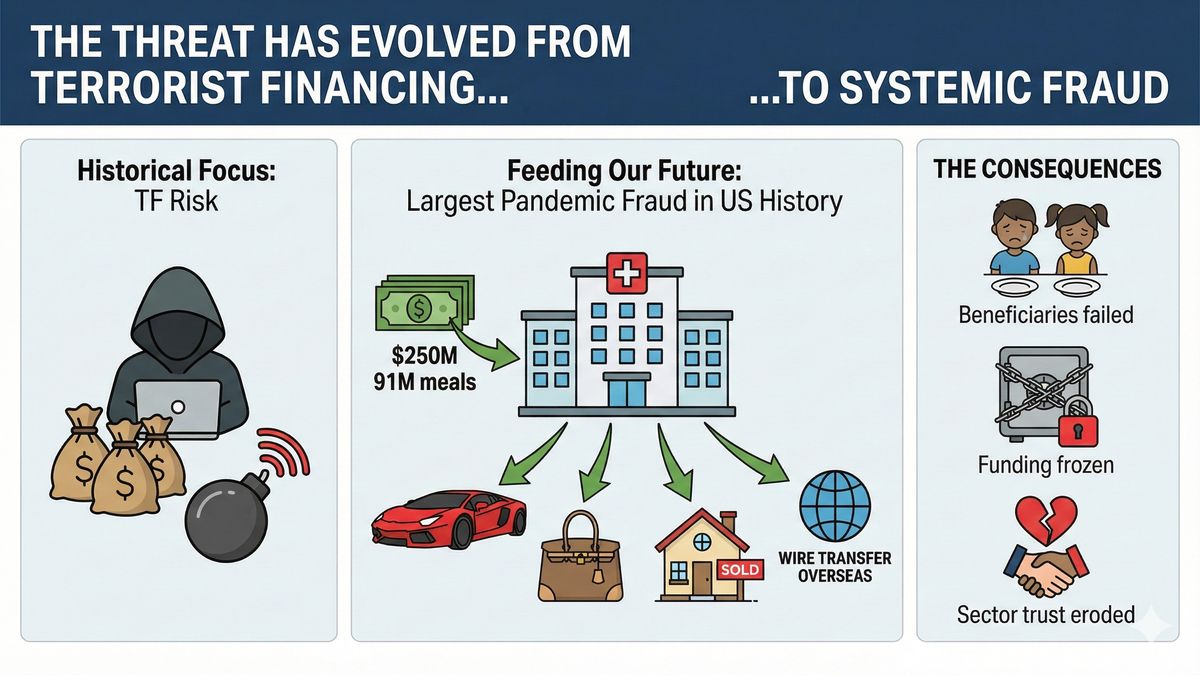
Historically, FATF Recommendation 8 was designed primarily to address terrorist financing risks. The concern was that NPOs operating in conflict zones or with cross-border fund flows could be exploited, wittingly or unwittingly, to channel funds to terrorist organisations.
That risk remains. What we see now:
Smaller NPOs are being exploited as unwitting conduits for fraud and money laundering. Limited resources mean limited controls, and criminals know it.
Larger, reputable NPOs are being targeted for "white-washing". Bad actors leveraging their good names to lend legitimacy to illicit funds. The bigger the brand, the better the cover.
Systemic fraud is emerging as a new category altogether, large-scale schemes that exploit programmes designed to help the vulnerable, turning the infrastructure of social good into machinery for theft.
This isn't just a compliance problem. It's an existential threat to the entire sector.
Case Study: Minnesota's Feeding Our Future Scandal
See: https://www.cbsnews.com/amp/news/minnesota-fraud-schemes-what-we-know/
If you want to understand what systemic fraud looks like, look no further than Minnesota.
In what federal prosecutors called "the largest pandemic-era fraud in the United States," a nonprofit called Feeding Our Future claimed to distribute tens of millions of meals to schoolchildren during COVID-19. The reality was starkly different.
The Scale
- $250 million fraudulently siphoned from the Federal Child Nutrition Programme
- 91 million meals claimed, most of which were never served
- 78 individuals indicted; over 60 convicted as of late 2025
- One site surveilled by the FBI claimed to serve 6,000 meals per day but actually averaged around 40 visitors
The Scheme
Feeding Our Future, founded in 2016 by Aimee Bock, operated as a sponsor under the USDA's Federal Child Nutrition Programme. During the pandemic, when schools closed and federal funding surged, the organisation enrolled hundreds of "meal sites" - restaurants, community centres, and storefronts that submitted fraudulent claims for meals never served.
Federal prosecutors allege that only around 3% of the funding granted to Feeding Our Future meal sites was actually spent on food. The rest was funnelled to individual conspirators who spent it on luxury cars, designer goods, property, and wire transfers overseas — including to banks in China and Kenya.
The Red Flags Ignored
Here's what makes this case so instructive: the warning signs were there from the beginning.
In July 2019, months before the pandemic, Minnesota Department of Education (MDE) officials identified early signs of fraud, including meal claims they considered implausible. By 2020, the MDE had labelled Feeding Our Future "severely deficient" and attempted to terminate the partnership.
But Bock fought back. She filed a lawsuit accusing the state of racial discrimination. A judge found no legal basis for stopping payments and ordered the state to continue processing applications. The MDE was even held in contempt of court and fined $47,500 for processing applications too slowly.
A subsequent report by Minnesota's Office of the Legislative Auditor found that "the threat of legal consequences and negative media attention" affected the state's decision-making process about regulatory action.
In other words: oversight failed not because the fraud was invisible, but because the system was ill-equipped to act on what it saw.
The Aftermath
The Feeding Our Future case was just the beginning. Federal investigators have since identified 14 Minnesota-linked programmes, including Medicaid-funded housing services, autism therapy for children, and emergency housing where providers allegedly billed for services never delivered.
Prosecutors estimate that total fraud across these programmes could exceed $9 billion.
Minnesota has become, in the words of U.S. Attorney Joe Thompson, "a national poster child for public corruption."
Why "Low Barriers to Entry" Backfires
One of the most troubling aspects of the Minnesota scandal is how programmes designed to help the vulnerable became vectors for fraud.
Take the state's housing stabilisation programme, designed to help seniors and people with disabilities find housing. Prosecutors noted that the programme was susceptible to fraud because it intentionally had "low barriers to entry" and few record-keeping requirements, features designed to make it accessible to those who needed it most.
Spending on the programme ballooned to more than $100 million last year, despite initial estimates that it would cost around $2.6 million annually.
This is the cruel paradox: the very design features that make social programmes accessible—simplified applications, minimal documentation, trust-based verification—are the same features that make them vulnerable to exploitation.
And it's not just local actors. Federal prosecutors charged two Philadelphia-based men with travelling to Minnesota specifically to defraud the housing programme, a phenomenon they described as "fraud tourism."
The Consequences
The fallout from Minnesota extends far beyond the state's borders.
For legitimate NPOs: When fraud of this scale emerges, it poisons the well for everyone. Banks become more cautious. Regulators tighten controls. Legitimate organisations face increased scrutiny and reduced access to funding.
For beneficiaries: The children who were supposed to receive those 91 million meals didn't get them. The seniors and disabled individuals who needed housing support found their programmes shut down. Mission failure isn't abstract. It has real human costs.
For the sector: Every scandal erodes public trust in the charitable sector as a whole. When donors see headlines about $250 million in fraud, they question where their own contributions are going.
The U.S. Department of Health and Human Services froze all federal child care funding to Minnesota in late 2025. Five states — California, Colorado, Minnesota, Illinois, and New York — sued the Trump administration over the freeze, calling it an unconstitutional abuse of power.
Whether or not the freeze was justified, the message is clear: when fraud reaches this scale, the response affects everyone, guilty and innocent alike.
The Lesson for NPOs Everywhere
Minnesota isn't unique. The conditions that enabled Feeding Our Future exist in jurisdictions around the world:
- Surge funding during crises
- Understaffed oversight agencies
- Programmes designed for accessibility rather than verification
- Political and legal pressure that inhibits regulatory action
If it can happen in Minnesota, it can happen anywhere, including in Malaysia, in Singapore, and across APAC.
The question isn't whether your organisation will face these pressures. It's whether you'll be prepared when they come.
What's Next
This is Part 2 of our 3-part series. In Part 3, we examine how criminals exploit NPOs from the outside using legitimate charities to launder their reputations.
Complete the series, then use our free NPO Vulnerability Checklist to identify gaps before someone else does.
JFourth works at the intersection of compliance, governance, and financial inclusion, helping organisations, including NPOs, build the capability to protect themselves and the people they serve. Get in touch to learn more about our training and advisory services.