
Case Study
"When Criminals Exploit Good Names: The White-Washing Threat"
Jan 13 · 9 min read
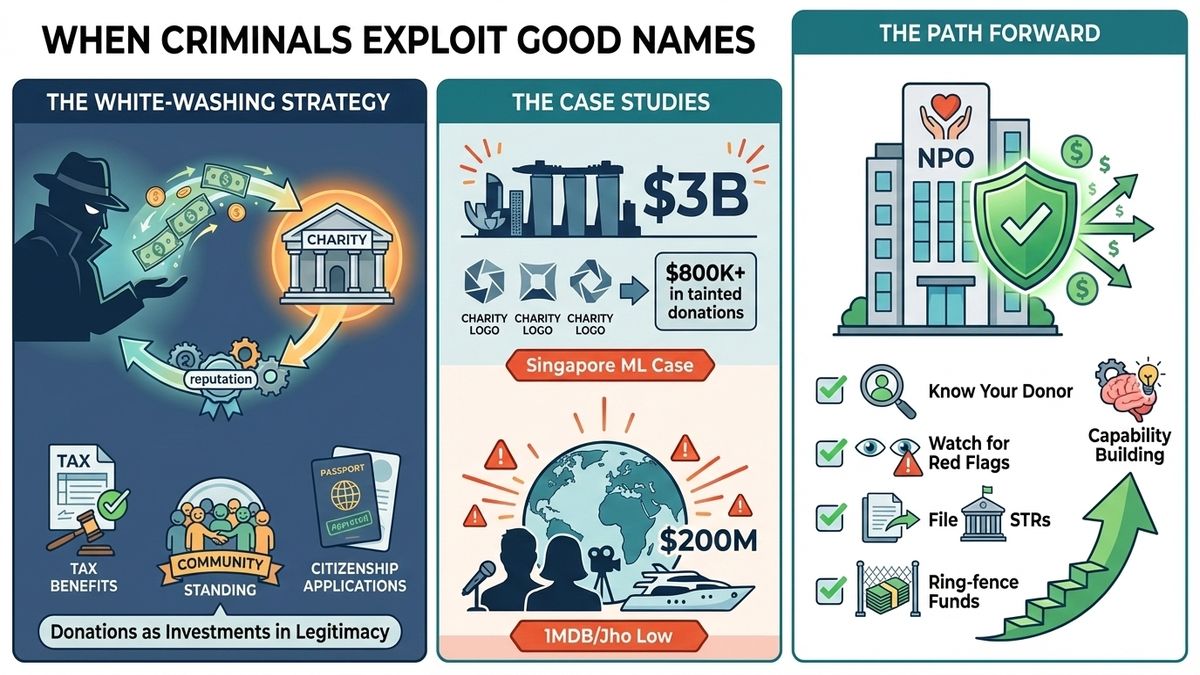
Part 3 of a 3-Part Series on Protecting Non-Profit Organisations Through Capability Building
What if the threat to your NPO isn't inside your organisation, but outside, using your good name without your knowledge?
In Part 1 of this series, we explored how NPOs' greatest strengths become their greatest vulnerabilities. In Part 2, we examined how systemic fraud can exploit programmes designed to help the vulnerable.
Now we turn to perhaps the most insidious threat of all: white-washing when criminals donate to legitimate charities not despite their crimes, but because of them.
The White-Washing Phenomenon
White-washing through philanthropy is deceptively simple. Criminals donate to reputable charities to:
- Lower their taxable income: legitimate tax deductions on illegitimate gains
- Gain goodwill and standing in the community: a veneer of respectability
- Support citizenship or residency applications: evidence of "community contribution"
- Influence investigations: leveraging relationships built through donations
- Launder their reputations: associating their names with good causes
The bigger the charity's brand, the better the cover. And the charity often has no idea it's being used.
Case Study: Singapore's $3 Billion Money Laundering Scandal
In August 2023, Singapore authorities conducted the largest anti-money laundering operation in the country's history. Over 400 officers raided properties across Tanglin, Bukit Timah, Orchard Road, and Sentosa Cove.
The Scale
| Category | Initial Report (Aug 2023) | Latest Status (2025) | | --- | --- | --- | | Total Value | S$1 billion+ | ~S$3 Billion (Surrendered: S$2.79B) | | Suspects | 10 Arrested | 10 Convicted & Deported (+ 17 Wanted) | | Cash/Crypto | ~S$23M Cash / S$30M Crypto | S$1.54 Billion (Financial Assets) | | Properties | 105 Prohibition Orders | 54 Sold (Liquidated by State) | | Luxury Items | ~250 bags/watches | 466 items + 58 Gold Bars (Auctioned) |
The Charity Connection
What emerged in the weeks following the arrests was troubling: at least five of the accused had donated six-figure sums to Singapore's most reputable charities.
| Charity | Amount Received | Donors | | --- | --- | --- | | President's Challenge | $350,000+ | Su Haijin, Su Baolin, Zhang Ruijin (via Sian Chay) | | Sian Chay Medical Inst. | ~$152,000 | Su Haijin, Su Baolin, Zhang Ruijin | | Rainbow Centre | $72,450 | Vang Shuiming, Su Haijin, Zhang Ruijin | | Community Chest | $30,000 | Multiple accused | | National Kidney Foundation | $14,500 | Su Baolin | | Lions Befrienders | $5,000 | One accused |
More than $800,000 in donations made by four convicted foreigners in the money laundering case have been surrendered to the authorities.
Why Did They Donate?
As one lawyer explained to The Straits Times: "Where the charity is legitimate, it could be to lower their taxable income, to obtain goodwill and standing in the community, or even just to acquire good karma."
But there was likely a more calculated motive. Reports emerged that some of the accused had tried to offer donations to clan associations in exchange for honorary titles - evidence of "community integration" that could support citizenship or permanent residency applications.
The donations weren't acts of generosity. They were investments in legitimacy.
The Response
Singapore's Commissioner of Charities issued an urgent advisory, urging all charities to review their donor records from as far back as January 2019 and file Suspicious Transaction Reports (STRs) if they found irregularities.
The charities responded swiftly.
But the episode exposed a painful truth: most charities lack the resources to conduct meaningful donor due diligence. As one charity leader admitted: "We have multiple sources of donations and a large volume of donors, and it is difficult to do in-depth checks on each of them."
Case Study: Jho Low and the 1MDB Scandal
If the Singapore case shows white-washing at a local level, the 1MDB scandal shows it on a global, celebrity-studded scale.
The Scale
- $4.5 billion+ allegedly stolen from Malaysia's sovereign wealth fund, 1MDB
- At least $200 million donated to charities by Jho Low (Low Taek Jho), the alleged mastermind
- Donations began after media scrutiny of his lavish lifestyle intensified, a deliberate PR strategy
| Charity | Amount | Notes | | --- | --- | --- | | MD Anderson Cancer Center | $50 million | Pledged after Low had a "cancer scare" | | United Nations Foundation | $25 million (pledged) | Targeted for IRIN (UN humanitarian news service) | | Panthera (Wild Cat Conservation) | $20 million | Low joined the board; org founded by Thomas Kaplan | | National Geographic Pristine Seas | $5 million | Pledged over 5 years | | Keep A Child Alive | $1 million+ | Matched Alicia Keys' donation to #WeAreHere | | Leonardo DiCaprio Foundation | "Millions" | Funded via charity auctions & art purchases |
Low also invested $150 million in Electrum Group LLC, whose founder ran Panthera. He joined the board briefly, embedding himself in legitimate business circles.
The White-Washing Strategy
Low's philanthropy wasn't random. It was strategic reputation management:
- Celebrity access: Donations bought him relationships with Leonardo DiCaprio, Alicia Keys, and other A-listers who publicly thanked him
- Legitimacy by association: His name appeared alongside respected institutions and causes
- Deflection: When media exposed his partying and celebrity payments, philanthropy offered a counter-narrative of a "legitimate businessman"
- Potential influence: Reports suggest Low may have attempted to use his charitable relationships to lobby against U.S. Department of Justice investigations
DiCaprio personally thanked Low as a "collaborator" in his 2014 Golden Globes acceptance speech. Low was given "special thanks" in the credits of The Wolf of Wall Street, a film about financial fraud, funded in part by allegedly stolen money.
The Dilemma
Celebrities eventually returned gifts. DiCaprio handed over a Picasso and Basquiat painting; Miranda Kerr returned $8 million in jewellery. But the charities kept the donations.
These cases expose a fundamental tension in the charitable sector:
Limited resources for due diligence: Most NPOs operate on thin margins. Conducting background checks on every donor, especially international donors, is simply not feasible.
Fear of rejecting legitimate donors: Overly aggressive screening could alienate genuine supporters. How do you distinguish a wealthy philanthropist from a criminal seeking legitimacy?
Reputational risk either way: Accept tainted money and face scandal. Reject a legitimate donor and face accusations of discrimination.
The Path Forward: Capability Building
Regulation alone cannot solve this problem. Charities need practical capability to protect themselves.
What NPOs Should Do
- Know your donor: Implement proportionate due diligence based on donation size and donor profile
- Watch for red flags: Mismatches between donor profile and donation size; "smurfing" (splitting donations to avoid thresholds); corporate donations from personal accounts; donors who are unusually eager for public recognition
- Document and escalate: Create clear procedures for flagging and escalating concerns
- File STRs when required: Don't wait for certainty. "Reasonable suspicion" is the threshold
- Ring-fence questionable donations: Segregate funds pending clarification rather than spending them immediately
What Banks and Regulators Should Do
- Support, don't abandon: De-risking NPOs entirely pushes them toward less transparent channels
- Provide guidance: Clear, practical advisories like Singapore's Commissioner of Charities did help NPOs understand their obligations
- Recognise proportionality: A small community charity cannot conduct the same due diligence as a multinational bank
What Donors Should Understand
Legitimate donors should welcome reasonable due diligence. It protects the causes they care about. Transparency is not an insult, it's a sign of a well-governed organisation.
FATF Recommendation 8 was designed to protect NPOs from terrorist financing exploitation. But the threat has evolved far beyond TF.
The February 2025 FATF Standards update introduced a critical shift toward proportionality, applying controls that match the actual risk profile of each organisation. This is welcome news for well-governed NPOs that have been unfairly burdened by blanket requirements, and cements the changes begun in late 2023, effectively mandating that banks and regulators must stop 'de-risking' low-risk NPOs and instead apply simplified due diligence where appropriate.
But proportionality cuts both ways. It means NPOs must be able to demonstrate their risk profile. They need governance frameworks, financial controls, and donor due diligence processes, even if scaled to their size and resources.
The organisations that build this capability will be better positioned to:
- Maintain banking relationships
- Attract institutional funding
- Protect their reputations
- Fulfil their missions without interruption
De-Risking Through Capability Building
Throughout this series, we've seen NPOs exploited in three ways:
- Internal exploitation - leaders misappropriating funds (Malaysia)
- Systemic fraud - NPOs as conduits for large-scale schemes (Minnesota)
- External exploitation - criminals using NPOs for white-washing (Singapore, 1MDB)
The common thread? Capability gaps. Insufficient governance. Inadequate controls. Limited resources for due diligence.
Regulation alone won't close these gaps. More rules don't help if NPOs lack the capacity to implement them. And blanket de-risking by banks punishes good actors while doing nothing to stop bad ones.
What's needed is capability building, equipping NPOs with the knowledge, tools, and frameworks to protect themselves. Not turning charities into compliance departments, but make available to them the minimum viable toolkit to:
- Understand their own risk exposure
- Implement proportionate controls
- Demonstrate their integrity to banks and regulators
- Detect and report suspicious activity
This is de-risking done right. Not through exclusion, but through empowerment.
Conclusion: The Stakes Are Real
The cases we've examined aren't abstract compliance failures. They represent real harm:
- In Malaysia, donations meant for the vulnerable ended up in personal accounts
- In Minnesota, children who should have received 91 million meals went hungry
- In Singapore, reputable charities had their names associated with criminals
- Globally, Jho Low used stolen Malaysian public funds to buy legitimacy through philanthropy
The NPO sector exists to serve those who need it most. When that trust is exploited—whether from inside or outside—it's not just the organisations that suffer. It's the beneficiaries. The donors. The communities that depend on the charitable sector to function with integrity.
The vulnerability paradox is real. The threats are evolving. But with the right knowledge and tools, NPOs can navigate this landscape without losing sight of their missions.
That's the path forward.
This is the final part of our 3-part series on the NPO Vulnerability Paradox. Across three continents and three very different cases, one pattern emerges: capability gaps leave NPOs exposed.
Download our free NPO Vulnerability Checklist to see where your organisation stands, and what to fix first.
JFourth works at the intersection of compliance, governance, and financial inclusion, helping organisations, including NPOs, build the capability to protect themselves and the people they serve. Get in touch to learn more about our training and advisory services for NPOs navigating AML/CFT requirements.